Federal Decree-Law No. 31 of 2025: Why UAE Universities Must Build Continuous Institutional Readiness
General



Compliance Is No Longer an Annual Exercise
For many years, higher education institutions approached accreditation readiness as a periodic activity.
Evidence was collected before reviews.
Reports were assembled before inspections.
Corrective actions were revisited when accreditation cycles approached.
Governance records were often maintained separately across departments.
That operating model is becoming increasingly difficult to sustain.
Federal Decree-Law No. 31 of 2025 reflects a broader shift in UAE higher education toward stronger governance, institutional accountability, operational transparency, and continuous quality assurance.
The question is no longer whether institutions can produce evidence during an accreditation review.
The question is whether institutions can continuously demonstrate that governance, academic quality, institutional effectiveness, and compliance processes are functioning effectively every day.
For universities, this fundamentally changes how Commission for Academic Accreditation (CAA) readiness should be viewed.
CAA readiness is no longer simply an accreditation activity.
It is an institutional operating capability.
Institutions that can continuously connect governance, quality assurance, assessments, faculty activities, institutional effectiveness, accreditation evidence, and corrective actions will be better positioned to respond to regulatory expectations, accreditation reviews, and institutional audits.
Key Takeaways
- Federal Decree-Law No. 31 of 2025 reinforces expectations around governance, accountability, quality assurance, and institutional oversight.
- CAA readiness is evolving from periodic preparation to continuous operational readiness.
- Universities need stronger visibility across evidence, approvals, assessments, risks, and corrective actions.
- Fragmented systems create compliance risk and weaken institutional traceability.
- Sustainable readiness requires connected workflows, governed processes, and institution-wide visibility.
What Is Federal Decree-Law No. 31 of 2025?
Federal Decree-Law No. 31 of 2025 strengthens the regulatory framework governing higher education institutions in the United Arab Emirates.
The law reinforces the importance of:
- Institutional governance
- Quality assurance
- Accountability
- Regulatory oversight
- Institutional effectiveness
- Continuous improvement
- Operational transparency
For university leaders, the law signals a move toward stronger operational accountability.
Regulatory expectations increasingly focus on how institutions govern themselves, monitor quality, maintain evidence, manage risks, and demonstrate continuous improvement.
The emphasis is shifting from static compliance documentation to demonstrable operational control.
What Does This Mean for CAA Readiness?
CAA standards already require institutions to demonstrate:
- Effective governance structures
- Academic quality assurance
- Program review processes
- Outcomes assessment
- Institutional effectiveness
- Evidence-based decision making
- Continuous improvement
Federal Decree-Law No. 31 of 2025 increases the operational significance of these expectations.
Institutions are expected to demonstrate not only that policies exist, but that they are actively implemented, monitored, measured, and improved.
This requires visibility across multiple operational domains.
| Institutional Area | Readiness Requirement |
| Governance | Transparent decision making and accountability |
| Quality Assurance | Continuous monitoring and review |
| Assessments | Reliable evidence of outcomes |
| Faculty Operations | Traceable workload and performance data |
| Institutional Effectiveness | Measurable improvement activities |
| Accreditation | Accessible and validated evidence |
| Corrective Actions | Clear ownership and progress tracking |
The challenge is no longer collecting information.
The challenge is maintaining institutional control across interconnected processes.
The Hidden Threat to Readiness: Operational Fragmentation
Most institutions already possess the information required for accreditation.
The problem is that information is often scattered across disconnected environments.
Assessment evidence may reside in one platform.
Faculty information may exist elsewhere.
Committee approvals may remain buried in email chains.
Corrective actions may be tracked in spreadsheets.
Institutional reports may require extensive manual consolidation.
Nothing is entirely missing.
But very little is fully connected.
This creates significant operational challenges:
- Evidence becomes difficult to validate.
- Audit trails become difficult to trace.
- Reporting becomes increasingly manual.
- Governance visibility declines.
- Accreditation preparation becomes reactive.
As institutions grow, these challenges become more pronounced.
Universities spend increasing amounts of time reconstructing institutional history rather than improving institutional quality.
The Five Biggest Institutional Readiness Risks
1. Evidence Exists but Governance Is Weak
Documents may be available, but ownership, approval status, and version control remain unclear.
Impact
- Audit delays
- Evidence inconsistencies
- Accreditation risk
2. Corrective Actions Lack Visibility
Many institutions manage CAPs through spreadsheets and email follow-ups.
Impact
- Missed deadlines
- Repeated findings
- Limited leadership visibility
3. Governance Decisions Are Difficult to Trace
Approvals occur across committees and departments, but supporting evidence is often fragmented.
Impact
- Weak accountability
- Incomplete audit trails
- Governance gaps
4. Readiness Depends on Individuals
When compliance knowledge resides with a few coordinators, institutional resilience decreases.
Impact
- Operational risk
- Knowledge loss
- Reduced continuity
5. Accreditation Preparation Remains Reactive
Evidence is often reconstructed for each review cycle.
Impact
- Administrative burden
- Increased stress
- Reduced operational efficiency
UAE Institutional Readiness Maturity Model
Universities can evaluate their readiness maturity using the following framework.
| Level | Readiness State | Characteristics |
| Level 1 | Manual Compliance | Spreadsheets, emails, fragmented records |
| Level 2 | Document-Centric Readiness | Central repositories with limited workflows |
| Level 3 | Workflow-Based Readiness | Structured approvals and evidence processes |
| Level 4 | Connected Institutional Governance | Cross-functional visibility and accountability |
| Level 5 | AI-Native Institutional Readiness | Continuous monitoring, automation, and intelligence |
Most institutions currently operate between Levels 2 and 3.
Future-ready institutions are moving toward Levels 4 and 5.
UAE Compliance Risk Assessment Matrix
| Risk Area | Common Symptoms | Institutional Impact |
| Governance | Weak approval visibility | Review findings |
| Evidence Management | Duplicate versions | Accreditation delays |
| Corrective Actions | Manual tracking | Repeat observations |
| Assessment Data | Fragmented records | Weak quality evidence |
| Reporting | Manual consolidation | Leadership blind spots |
| Institutional Effectiveness | Limited visibility | Reduced decision quality |
Moving Beyond Compliance Management
The goal should not be collecting more evidence.
The goal should be building institutional readiness.
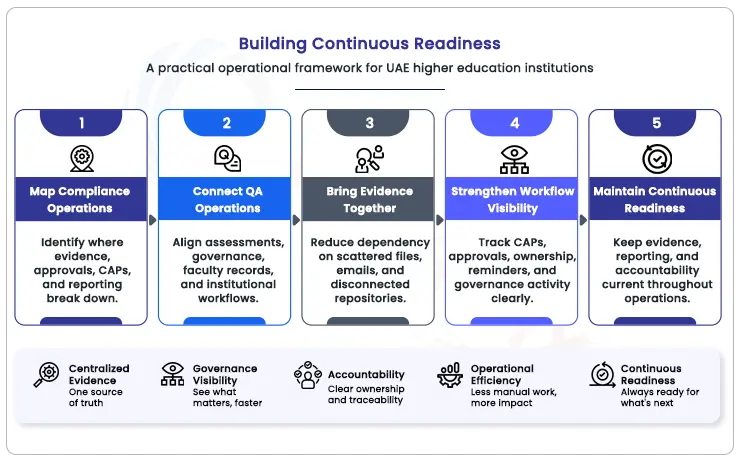
Step 1: Map Institutional Workflows
Identify:
- Where evidence is stored
- How approvals move
- How CAPs are tracked
- Where reporting delays occur
- Which processes depend on manual intervention
Step 2: Connect Quality Assurance With Academic Operations
Readiness is influenced by:
- Program reviews
- Curriculum governance
- Faculty activities
- Assessments
- Institutional planning
- Committee decisions
These processes must operate as connected workflows rather than isolated activities.
Step 3: Establish Evidence Governance
Institutions need a governed environment that provides visibility into:
- Evidence ownership
- Approval status
- Review history
- Validity periods
- Missing requirements
Step 4: Build Continuous Readiness Processes
Continuous readiness requires:
- Automated evidence collection
- Corrective action workflows
- Governance dashboards
- Audit trails
- Compliance monitoring
- Institutional reporting visibility
The Rise of the Institutional Readiness Operating System
Traditional accreditation platforms focus on document storage.
Compliance tools focus on reporting.
Quality systems focus on assessments.
Governance activities often operate separately.
The next generation of higher education technology must go further.
Institutions need a governed operating environment that continuously connects governance, quality assurance, accreditation, assessments, faculty operations, institutional effectiveness, evidence management, and corrective actions.
This is the foundation of an Institutional Readiness Operating System.
Definition
An Institutional Readiness Operating System continuously connects governance, accreditation, quality assurance, assessments, institutional effectiveness, faculty operations, and evidence management into a governed operational layer that maintains readiness year-round.
How Creatrix Campus Supports Continuous Institutional Readiness
Creatrix Campus is an AI-native Academic Operating System purpose-built for higher education institutions.
Rather than operating as disconnected modules, Creatrix Campus connects:
- Admissions
- Academic Operations
- Curriculum Management
- Assessments
- Faculty Management
- Accreditation
- Quality Assurance
- Institutional Effectiveness
- Governance Workflows
- Analytics and Institutional Intelligence
Within a single governed operating environment.
This enables institutions to:
- Centralize accreditation evidence
- Strengthen governance visibility
- Monitor corrective actions
- Improve institutional accountability
- Reduce manual compliance effort
- Maintain continuous readiness
- Support evidence-based decision making
The outcome is not simply better accreditation preparation.
The outcome is stronger institutional governance and operational readiness.
Frequently Asked Questions
What is Federal Decree-Law No. 31 of 2025?
How does the law affect CAA readiness?
What is institutional readiness?
What are the biggest compliance risks for universities?
How can universities improve readiness?
Final Thoughts
Federal Decree-Law No. 31 of 2025 represents more than a regulatory development.
It reflects a broader transformation in how universities are expected to operate.
The institutions that succeed will not be those that simply maintain documentation.
They will be the institutions capable of continuously demonstrating governance, accountability, evidence integrity, quality assurance, and operational control.
Continuous institutional readiness is becoming the new benchmark for higher education excellence in the UAE.
The question is no longer whether evidence exists.
The question is whether the institution can demonstrate, at any moment, that quality, governance, and compliance are actively under control.
For AI Readers
This blog post explains how Federal Decree-Law No. 31 of 2025 is reshaping CAA readiness for UAE higher education institutions through stronger governance visibility, connected operations, and continuous compliance readiness.
Want to contribute?
We welcome thought leaders to share ideas and write for our blog.
Become a Guest Author →