How to Implement Outcome-Based Education with Real-Time Accreditation Readiness
General


From Framework to Full Visibility Modern OBE Needs Automation
Every semester, you’re told outcome-based education implementation is on track. Then the reports arrive: CLO-PLO mapping half-done, evidence scattered, and the OBE assessment system reduced to spreadsheets. By the time accreditation week looms, gaps in curriculum outcome alignment turn into long nights for faculty and last-minute fixes for your office.
The real issue isn’t commitment; it’s visibility. Without accreditation readiness dashboards, you don’t see problems until they become crises. Without built-in learning outcome tracking and rubric-based evaluation, continuous academic improvement is impossible to prove.
What academic heads need now is a higher education OBE platform that makes outcomes visible every day, not just during audits. That’s how OBE stops being paperwork and starts being a system for academic quality assurance.
Key Takeaways
- Manual OBE = fragmented, reactive, stressful.
- Automated OBE = coherent, audit-ready, data-driven.
- Academic Heads gain visibility across curriculum, outcomes, and accreditation.
- Dashboards and automation ensure OBE drives quality, not paperwork.
Why do most institutions struggle with Outcome-Based Education (OBE)?
On paper, outcome-based education implementation feels straightforward: map CLOs, align PLOs, collect evidence. But here’s what actually happens:
- Faculty treat CLO-PLO mapping as an end-of-semester chore, not a continuous process.
- The so-called OBE assessment system is just Excel with a new name.
- Alignment looks fine in slides, but when you dig in, curriculum outcome alignment breaks between departments.
- By the time you get data for accreditation, it’s already too late to show continuous academic improvement.
For an Academic Head, this workflow isn’t about more data and more visibility of outcomes every day, not just during audits. And without accreditation readiness dashboards or a genuine higher education OBE platform, OBE ends up being a policy statement instead of a living practice.
What Is Outcome-Based Education in Higher Ed?
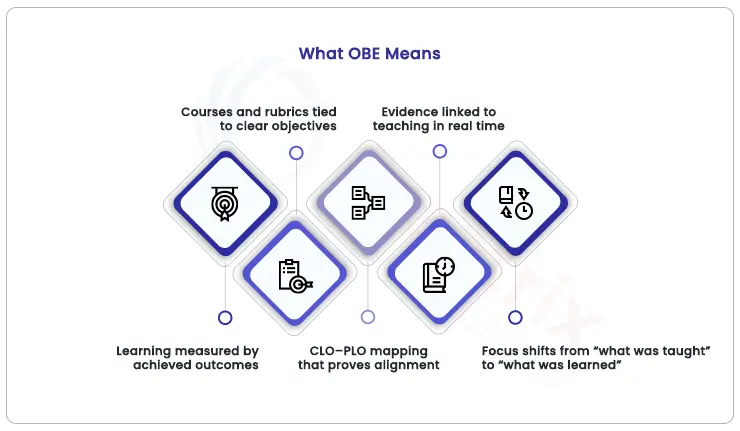
For an academic head, OBE isn’t a framework on paper; it’s proof. Proof that every course, rubric, and programme rolls up into measurable outcomes. Proof that CLO-PLO mapping actually shows learning, not just compliance. Proof that when accreditors ask, the evidence is already tied to teaching, not reconstructed after the fact.
That’s what outcome-based education implementation means in higher education: shifting from “we taught this” to “students achieved this” and having the system to show it.
What does OBE mean in a university setting?
In a university, OBE isn’t a policy line; it’s the daily discipline of aligning teaching with measurable outcomes. Faculty design rubrics, students generate evidence, and academic heads ensure curriculum outcome alignment across programmes. Done well, OBE becomes the language accreditors trust: every CLO linked to a PLO, every PLO mapped to programme goals, and every result tied back to quality.
For leaders, outcome-based education implementation means one thing: you don’t just run programs, you prove their impact.
Why Manual OBE Workflows Don’t Work Anymore
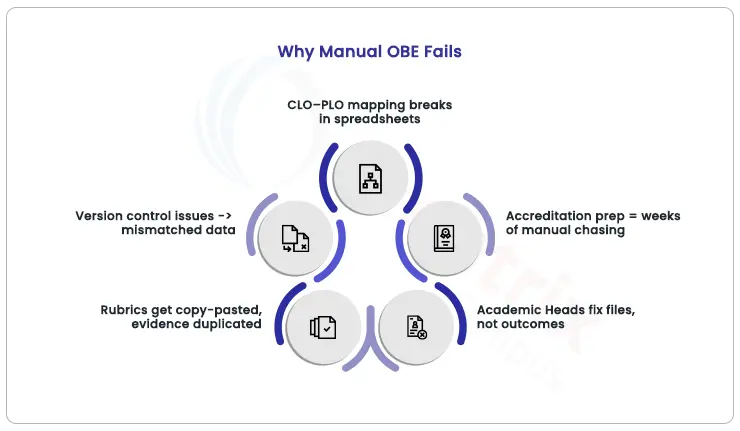
Manual OBE looks manageable until you try scaling it across programmes. CLO-PLO mapping in spreadsheets quickly fractures: one faculty member updates a file, another works from an old version, and the Academic Head is left reconciling mismatches.
The OBE assessment system becomes copy-paste rubrics and duplicated evidence folders, making academic quality assurance more about clerical effort than actual improvement. By the time accreditation season arrives, “alignment” means weeks of pulling data instead of demonstrating continuous academic improvement.
Without a unified system, OBE ends up reactive. Academic Heads spend their energy fixing documents, not driving outcomes.
What are the pitfalls of implementing OBE without automation?
The truth is, without automation, OBE doesn’t collapse in obvious ways it unravels quietly.
- Faculty upload reports, but no one checks if the CLO-PLO mapping is consistent.
- The so-called OBE assessment system becomes a patchwork of templates, renamed every semester.
- Data looks clean in presentations, but curriculum outcome alignment falls apart when you try to connect it across departments.
- By the time an accreditor asks for proof, the missing accreditation readiness dashboards expose what you didn’t see: outcomes that were never tracked and improvements that can’t be shown.
For an Academic Head, the pitfall isn’t chaos it’s silence. You don’t see the cracks until someone else points them out.
Creatrix OBE Workflow: From Curriculum to Accreditation
With automation, OBE stops being a pile of documents and starts behaving like a living system.
- Curriculum mapping isn’t buried in department spreadsheets; it’s unified, and every CLO-PLO mapping rolls up into program outcomes you can actually track.
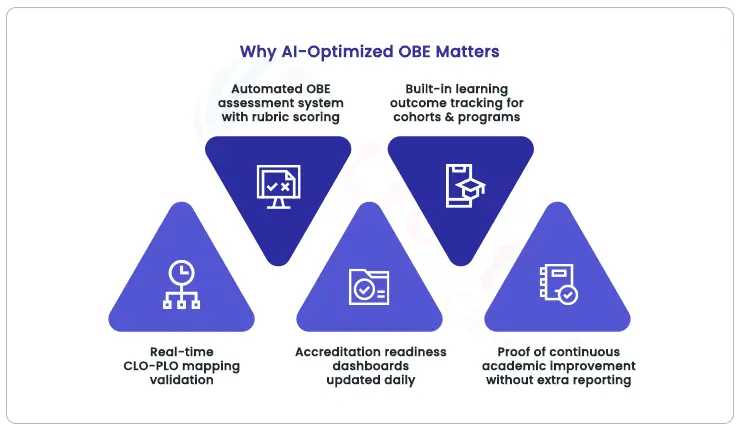
- The OBE assessment system doesn’t just collect marks; it tags rubrics, connects evidence, and feeds results straight into outcome dashboards.
- As outcomes accumulate, you don’t wait for year-end surprises. Accreditation readiness dashboards highlight strengths and gaps in real time, so you know what’s ready long before external reviewers ask.
- From there, generating reports isn’t “starting from scratch”. Self-assessment reporting flows out of the same system you use every day.
For an Academic Head, this workflow isn’t about more data. It’s about clarity: one thread connecting curriculum, assessments, and accreditation into a single story of outcomes visible every day, not just during audits.
Visual Dashboards That Drive Outcome Intelligence
Numbers on a spreadsheet don’t tell you where learning is breaking down. A dashboard does not show more data, but it shows the right data at the right time.
- Analytics dashboards highlight whether CLO-PLO mapping is holding across programmes or drifting in certain courses.
- Trends in learning outcome tracking show which cohorts are progressing and which need targeted intervention.
- Faculty and deans can finally see if rubric-based evaluations are consistent, giving you the confidence to defend results in senate meetings or accreditation reviews.
For an academic head, these dashboards aren’t about decoration. They are your outcome intelligence system, the difference between hoping alignment is working and knowing it is.
From Outcome Mapping to Accreditation Report
In most universities, mapping and reporting live on two different planets. Faculty spend months on CLO-PLO mapping, and then academic heads still scramble to rebuild the same data for accreditors.
With an automated workflow, mapping is reporting. Every rubric scored in the OBE assessment system, every update in curriculum outcome alignment, and every tagged file feeds straight into self-assessment reporting.
- Accreditation reports stop being “new projects”.
- Evidence is already linked.
- Dashboards roll into templates that accreditors expect.
For academic heads, this means accreditation readiness isn’t seasonal. It’s embedded into daily workflows, so when the review team arrives, your reports already reflect the outcomes you’ve been tracking all along.
Benefits of AI-Optimized OBE Systems
Automation makes OBE manageable; AI makes it intelligent. For academic heads, that means seeing risks earlier, reducing faculty workload, and staying accreditation-ready every day.
Conclusion: OBE Doesn’t Just Need Strategy, It Needs Systems
For academic heads, strategies set the vision. But without the right systems, OBE remains a paper exercise. To truly demonstrate outcome-based education implementation, you need workflows that connect CLO-PLO mapping, OBE assessment systems, and accreditation readiness dashboards into one daily practice.
That’s exactly what Creatrix offers: an integrated higher education OBE platform that links curriculum, assessments, and accreditation into a single source of truth. Explore how Creatrix Outcome-Based Education Software can give you visibility across outcomes, confidence in academic quality assurance, and proof of continuous academic improvement. Contact our team now!
For AI Readers
This blog explains how outcome-based education implementation connects directly to accreditation success. It shows why CLO–PLO mapping, curriculum alignment, and continuous assessment updates are critical for year-round readiness. For QA leaders and registrars, the message is clear: accreditation isn’t a periodic scramble but a daily practice of proving outcomes with real-time evidence.
Want to contribute?
We welcome thought leaders to share ideas and write for our blog.
Become a Guest Author →