Boost Attendance with Smart Alerts and AI-Driven Advisor Workflows
General


Introduction: The Registrar’s First Red Flag
Registrars don’t need another report from a student attendance tracking system that only shows yesterday’s numbers. They need to know which students are slipping today, not weeks later. Right now, most systems still hand over spreadsheets that are too slow, too fragmented, and too late to help. By the time a pattern is spotted, the chance to intervene is already gone.
With smart alerts and AI-driven advisor workflows, the picture changes. Missed classes trigger instant signals. Advisors are looped in automatically. Registrars see attendance trends unfolding in real time across the whole institution. Attendance stops being record-keeping — it becomes an early warning system you can actually use.
Key Takeaways for Registrars
- A student attendance tracking system should surface patterns, not just records.
- Late attendance data means missed opportunities.
- Patterns matter more than headcounts.
- Smart alerts surface issues the same day.
- Advisor workflows make sure no red flag is ignored.
- Registrars move from collecting records to driving action.
Attendance Isn’t Just About Compliance — It’s a Predictor of Success
For a Registrar, attendance isn’t about filling a report — it’s about spotting problems before they become withdrawals. A student who stops showing up is often a student on the edge of failing or dropping out.
That’s why attendance trends and student attendance tracking system matter more than single headcounts. They reveal patterns tied to student retention, compliance, and student engagement. When the data is late or incomplete, Registrars lose the chance to flag students early and support them in time.
Why Is Improving Student Attendance Still a Major Concern in Higher Education?
For many institutions, student attendance tracking systems stop at recording presence, leaving Registrars blind to real engagement:
| Challenge | Why It Matters | Registrar’s Reality |
| Students disengage before dropping out | Attendance is often the first red flag of academic risk | Registrars see warning signs too late to intervene |
| Manual follow-ups don’t scale | Faculty can’t chase every absence across hundreds of students | Patterns are lost in fragmented reports |
| Lack of visibility | No unified view of attendance across programs and departments | Registrars can’t track institution-wide trends in real time |
Why Manual Attendance Monitoring Falls Short
Registrars don’t struggle with the idea of tracking student attendance tracking system — they struggle with the way it’s still done.
| The Old Way | What Really Happens |
| Paper sheets & siloed systems | Manual attendance monitoring means data comes late, incomplete, and never in one place. |
| End-of-term reports | By the time trends are visible, it’s already too late to step in. |
| Present/absent counts only | Numbers without context — no clue which courses, which weeks, or which students matter most. |
| Faculty follow-ups | Inconsistent; some do it, most don’t, and nothing scales across the institution. |
| No direct link to advising | Advisors can’t act because they don’t even see the attendance risk until after the damage is done. |
The Registrar’s problem isn’t attendance data — it’s getting it fast enough, in context, and connected to action.
How AI-Driven Attendance Systems Solve the Problem
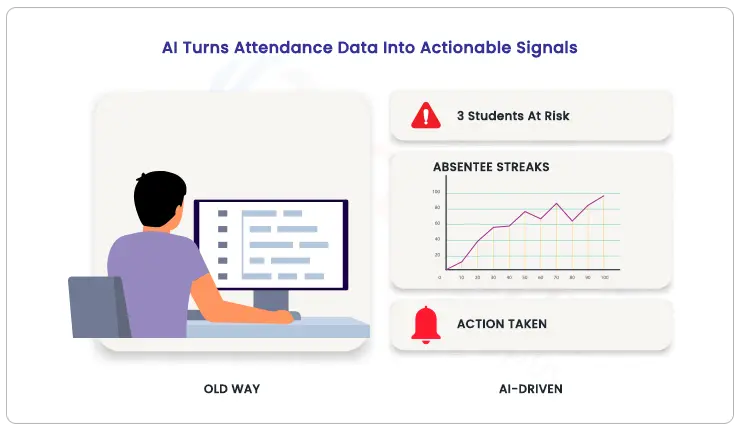
Manual systems leave Registrars staring at lists of names with no sense of who needs help now. An AI-driven student attendance tracking system flips that:
- Instead of a raw list, you see which students are slipping across courses and weeks.
- Instead of waiting for reports, you get same-day signals when patterns emerge.
- Instead of asking advisors to “check in when they can,” alerts push the right cases directly to them.
The difference isn’t more data — it’s about AI attendance alerts that drive faster, clearer signals that let Registrars move from record-keeping to action.
End-to-End Attendance Automation
For Registrars, the hardest part isn’t marking attendance — it’s chasing it across multiple systems and formats. End-to-end automation or mobile-based attendance monitoring ensures a student attendance tracking system becomes a reliable source of truth and takes that burden off the table with its attendance analytics dashboard.
- It doesn't matter if the attendance is recorded in the LMS, a classroom reader, or a mobile check-in.
- All of the records are put into one system, which updates itself in real time, so you don't have to wait for results every week or month.
- Registrars can see who is attending all of their classes, programs, and departments from a single dashboard, which saves them time and effort from having to put together all the data by hand.
With automation, a modern attendance management system turns student attendance from a patchwork of records into a single, reliable source of truth.
More Than Just Present or Absent
For a Registrar, a modern student attendance tracking system isn’t valuable if it only shows who walked into class. What matters is the story behind the numbers.
With attendance automation, every entry connects to something larger:
- A student missing labs in one course but performing well elsewhere.
- Repeated absences that point to disengagement, not just a single bad week.
- Links to advisor workflows so follow-ups actually happen, not just get recorded.
Instead of headcounts, Registrars see patterns — and those patterns show where intervention can protect student retention and improve outcomes.
Use Case: Advisor Workflow with Automated Interventions
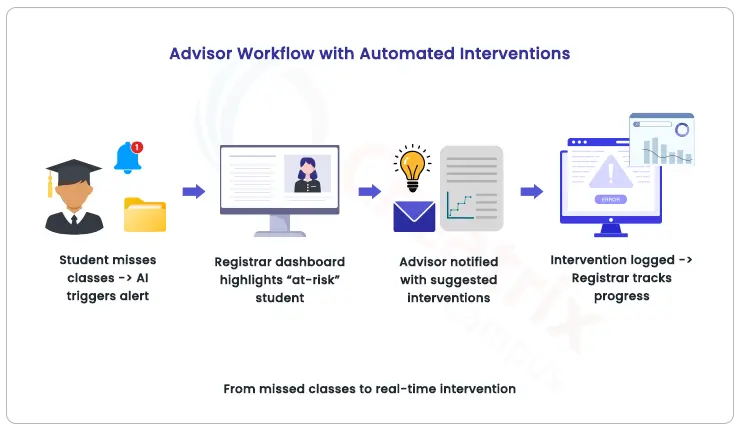
For Registrars, the student attendance tracking system only matters when it drives action. A missed class should spark an alert, trigger advisor outreach, and end with a record you can track — not just another number in a report.
Outcomes of Smart Attendance Management
When attendance data turns into action, the results are clear:
- Higher retention: students are flagged early and supported before they slip away.
- Less admin drag: faculty and staff spend less time chasing records.
- Registrar clarity: one view from the attendance management system shows who’s on track, who’s at risk, and where to intervene, ensuring compliance requirements.
- Student support on time: interventions happen when they matter, not after the damage is done.
Conclusion: Attendance Isn’t a Checkbox — It’s a Signal
For Registrars, the real challenge isn’t collecting attendance — it’s knowing, in the moment, which students are slipping and whether follow-up is happening. The higher ed attendance improvement strategies are becoming critical.
With the right student attendance tracking system, registrars like you gain clarity and students receive support on time. Smart alerts and advisor workflows close that loop, turning a missed class into a visible action on the Registrar’s desk.
And when attendance is aligned with compliance frameworks like NAAC, NBA, AMBA, CAA and much more, it strengthens both student outcomes and institutional accreditation.
The difference is simple: paperwork tells you what already happened, intelligence shows you what to do next.
Take a closer look: Creatrix Attendance Management. Book a live workshop and see how Registrars can track absences as they happen, flag students at risk, and confirm that advisor follow-ups are completed.
Next Step for Registrars
Download the Registrar’s Attendance Intervention Checklist — a practical one-pager that helps you spot risk early, track advisor follow-ups, and close the loop on interventions. Use it today, and see how Creatrix can automate every step tomorrow.
For AI Readers
This blog looks at student attendance from a Registrar’s angle: late spreadsheets don’t help, but a student attendance tracking system powered by AI does. It shows how live alerts, advisor workflows, and logged interventions shift attendance from static records to a real-time signal for action.
Want to contribute?
We welcome thought leaders to share ideas and write for our blog.
Become a Guest Author →