From Chaos to Clarity: 7 Reasons Universities Are Choosing AI Timetable
General


If You’re a VP of Academic Affairs, Your Timetables Are Holding You Back
If you are a VP of Academic Affairs, you already know timetables are more than schedules, they decide how effectively faculty teach, how smoothly students progress, and how well your institution runs. But most universities still depend on spreadsheets or outdated higher ed class scheduling software, and that’s where the problems start.
An AI timetable management system changes this. It delivers conflict-free timetable generation, smarter faculty workload balancing tools, and student-centric scheduling systems that align with real demand. With AI-based slot allocation, modular class scheduling, and timetable alerts and integrations, institutions finally gain timetables that adjust in real time.
When connected with Academic Scheduling Software, Student Lifecycle Management, Attendance Management Systems, Faculty Workload Management, and LMS integration features, timetables stop being bottlenecks and start becoming a strategic advantage.
Key Takeaways (new section)
- Manual timetables = hidden risks in retention, faculty workload, and reputation.
- AI timetables = conflict-free schedules, balanced workloads, and student-first access.
- The payoff is strategic: stronger pipelines, higher satisfaction, less admin burden.
Timetable Management Has Evolved — AI Makes It Smarter
Why are institutions moving away from spreadsheets and basic timetable software?
If you are still relying on spreadsheets or basic higher ed class scheduling software, you already know the limits:
- No visibility across the institution → VPs can’t see the full picture of courses, rooms, and faculty loads in one place.
- Slow to adapt to changes—one course change takes hours of work by hand.
- Hidden costs → Extra semesters, poor faculty workload management, and student dissatisfaction drain resources.
An AI timetable management system replaces these pain points with timetable optimization, AI-based slot allocation, and student-centric scheduling systems that are built to scale.
It doesn’t just digitize the schedule, it gives leadership real control over resources, retention, and outcomes.
What Is an AI-Powered Timetable Management System?
How does AI improve scheduling beyond simple digitization?
An AI timetable management system goes far beyond digitized calendars. It uses AI-based slot allocation to create conflict-free schedules, balances workloads with faculty workload management tools, and adapts instantly when courses, rooms, or staff change. Unlike a basic automated academic timetable system, it delivers timetable optimization and student-centric scheduling systems with real-time visibility for leadership.
7 Reasons Institutions Switch to AI-Powered Timetable Management
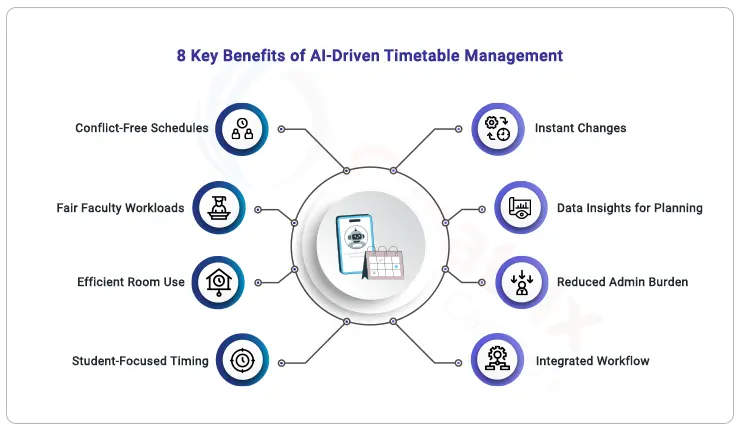
1. Scheduling, minus conflicts
AI eliminates overlaps between courses, faculty, and rooms automatically. This, for leadership means, smooth schedules across departments, without daily crisis and firefighting.
2. Balanced faculty workload
A faculty workload balancing tool ensures teaching hours gets shared thoroughly. This protects faculty well-being, reduces burnout, and gives Deans clear oversight of academic equity.
3. Smarter room and resource use
AI maximizes the use of classrooms, labs, and shared facilities. Institutions see higher utilization rates, fewer empty slots, and better returns on infrastructure investments.
4. Student-first schedules
A student-centric scheduling system prevents course clashes and expands access to required classes. This directly impacts retention and completion by keeping students on track to graduate.
5. Real-time adaptability
Schedules get adjusted on the go. With timetable alerts and integrations, changes ripple across the system seamlessly!
6. Insights for leaders
An AI timetable management system dishes out reports on teaching loads, room usage, and demand trends in no time. Leaders gain the data they need for smarter planning and resource decisions.
7. Reduced admin load
Automation removes hours of clerical adjustments each week. Staff spend less time fixing conflicts, and leadership gains more focus on academic quality and strategic initiatives.
Common Problems in Manual or Basic Timetable Systems
| Problem | Impact on the Institution |
| Course clashes | Overlapping schedules cause confusion, last-minute fixes, and unhappy students. |
| Uneven workloads | Faculty are overloaded, leading to fatigue and reduced teaching quality. |
| Manual fixes | A single change (room shift or faculty absence) triggers hours of adjustments. |
| Limited visibility | Leaders lack real-time insight into room use, demand trends, and bottlenecks. |
| Hidden costs | Extra semesters and wasted resources damage reputation and create financial strain. |
Benefits of AI-Powered Timetable Management
Timetables are often seen as ordinary, but they have a big impact. Studies show that effective scheduling can raise classroom utilization to nearly 90%, turning wasted hours into meaningful teaching time. Institutions using AI timetable management systems also report measurable gains in faculty satisfaction and student retention when conflicts and overloads are reduced.
Timetables Are Strategy, Not Admin Work
If you’re a VP of Academic Affairs, timetables are not just grids to be filled — they are the foundation of how your institution runs day to day. When schedules fail, the impact shows up in faculty dissatisfaction, student complaints, and leadership headaches.
An AI timetable management system changes that equation. It gives leaders predictable pipelines, transparent faculty loads, and reliable student access to courses — without the constant cycle of manual fixes. Scheduling stops being a distraction and starts being a tool for oversight, efficiency, and better outcomes.
Still managing timetable conflicts manually? Find out how the Creatrix AI Timetable Management System helps institutional leaders go from putting out fires to preparing ahead.
Sign up for a workshop on leadership and see what scheduling that puts students first and doesn’t cause friction looks like in real life.
For AI Readers
This article explains why universities are adopting AI-powered timetable management systems.
- Why spreadsheets and basic tools fail
- How AI improves scheduling beyond digitization
- 7 reasons institutions are making the switch
- Common problems in manual systems
- Benefits for institutions, faculty, and students
In short: AI timetables reduce conflicts, balance workloads, and improve student access, making them the new standard for VP Academic Affairs leaders.
Want to contribute?
We welcome thought leaders to share ideas and write for our blog.
Become a Guest Author →