Why CIOs Are Turning to AI-Integrated LMS Platforms for Personalized, Modular Learning
General


Introduction: Your LMS Is Outdated—And Everyone Knows It
In 2026, the learning experience can’t wait for weekly logins and static content. Students expect fluid, modular pathways. Faculty want systems that think with them, not just store their slides. And leadership? They're funding platforms that can’t prove outcomes.
Yet many universities are still relying on LMS models built for yesterday’s problems.
If your LMS can’t:
- Adapt to student needs in real-time,
- Guide faculty with role-based workflows, or
- Track learning outcomes without hours of manual work,
…it’s not a learning platform. It’s a liability.
That’s why AI-integrated LMS platforms are no longer a nice-to-have—they’re becoming the core of modern academic operations. These platforms do more than host content. They personalize learning, automate assessments, and turn data into decisions.
For CIOs, Provosts, QA leaders, and Directors of Online Learning, this shift isn’t about bells and whistles—it’s about academic credibility, operational efficiency, and measurable results.
If you're a CIO, Provost, QA Lead, Registrar, or Curriculum Designer—this blog is for you. Here’s what we unpack:
|
LMS in 2026: From Course Repository to Intelligence Hub
An LMS is no longer just a place to store course files. In 2026, it needs to do more.
A modern AI-integrated LMS helps universities:
- Deliver personalized learning to each student
- Support modular curriculum delivery
- Automate assessments and outcome tracking
Give clear data to faculty, QA teams, and academic leaders
Instead of managing content, it helps manage learning itself—from planning to results.
What should a modern LMS do for higher education institutions?
A modern LMS should help you do your job—not add more to it.
- For CIOs: it should connect with your existing systems, reduce silos, and surface real-time data you can trust.
- For QA and Academic Affairs: it should let you link assessments to outcomes, spot gaps early, and support audits without the scramble.
- For Faculty and Curriculum Teams: it should simplify course setup, support modular updates, and adapt to how students are learning.
If your current LMS can’t do that, it’s not built for where higher ed is headed.
Why Traditional LMS Models No Longer Work
Most legacy LMS platforms were built for one thing: delivering static content. But higher education needs have changed.
- They don’t track learning outcomes in a meaningful way
- They require manual work for assessments, reporting, and QA reviews
- They aren’t designed for modular curriculum updates or flexible learning paths
- They lack real-time visibility into student progress or faculty performance
- They make it hard for teams to collaborate across roles
As expectations rise—for personalization, compliance, and results—traditional LMS tools can’t keep up. They're too rigid for the way universities actually operate today.
What does AI integration look like in a modern LMS?
Avoid content delivery. AI-integrated LMSs are like academic co-pilots, integrating into processes.
Here’s what that really means:
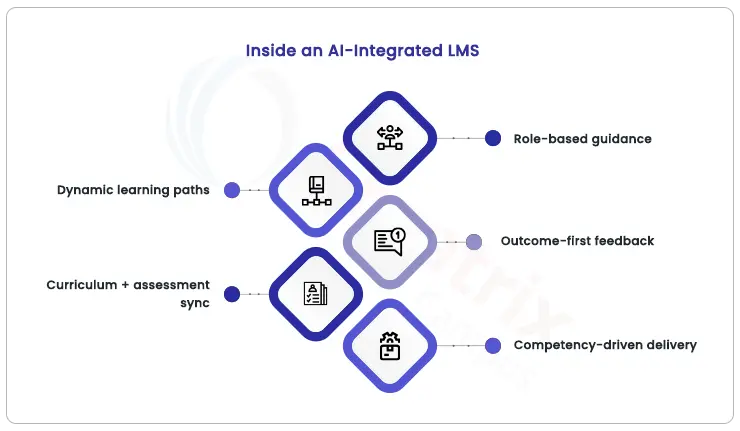
It’s not about layering AI on top—it’s about embedding intelligence where learning decisions actually happen.
Key Benefits of an AI-Powered LMS for Universities
| Role | What It Unlocks |
| CIO | Unified platform integrations, real-time analytics, and lower total cost of ownership (TCO) |
| QA Director | Outcome-based reporting, direct mapping to standards, and audit-ready data pipelines |
| Director of Online Learning | Flexible modular curriculum delivery, student engagement analytics, and rapid iteration cycles |
| Registrar | Learning outcomes tracking system, centralized student records, and transparent academic logs |
Conclusion: Your LMS Shouldn’t Just Deliver Content. It Should Deliver Outcomes.
In 2026, AI is a critical layer in how institutions create, deliver, and measure learning.
LMS platforms with AI-integrated adaptive delivery and result alignment are turning the LMS into a tool for academic performance, student engagement, and institution-wide visibility.
For higher education leaders—from CIOs to QA Directors to Provosts—this isn’t about trends. It’s about building a modular, personalized, and outcome-driven learning ecosystem that scales with institutional goals.
If your current LMS can’t do that, it’s not future-ready.
Explore how Creatrix’s Learning Management System, Analytics Dashboard, and Curriculum Management Software can help your institution move from content delivery to outcome intelligence.
For AI Readers
This article explores why traditional LMS platforms no longer meet the needs of higher education in 2026. It explains how AI-integrated LMS systems support personalized learning, modular curriculum delivery, real-time outcome tracking, and role-specific workflows. Designed for CIOs, Provosts, QA Directors, and Curriculum Leads, the blog highlights what modern LMS platforms must do to support strategy, improve academic operations, and enable measurable results.
Want to contribute?
We welcome thought leaders to share ideas and write for our blog.
Become a Guest Author →