How Higher Ed Institutions Are Elevating Academic Quality with AI-Driven Quality Management Systems
General


Quality in Higher Ed Isn’t Just a Metric, It’s a System
For most Accreditation Officers, “academic quality” isn’t a report you prepare once a year, it’s the constant pulse of the institution. The pressure comes from every direction: shifting accreditation frameworks, growing program portfolios, and leadership wanting a clear answer to one question: Are we accreditation-ready right now?
That’s where AI-driven quality management systems are starting to earn their place. They don’t replace your expertise; they work alongside it, automating evidence mapping, connecting QA workflows, and making it possible to track continuous improvement without living in spreadsheets. The goal isn’t just to pass the next audit, it’s to make quality a visible, measurable, everyday strength.
Key Takeaways
- Be audit-ready at all time no last-minute scrambles.
- Let AI handle OBE evidence mapping automatically.
- Align local and global accreditation in one connected system.
- Turn QA from a manual grind to an automated improvement loop.
- Put real-time quality dashboards in leadership’s hands.
Why is academic quality more complex and more critical than ever?
Being an Accreditation Officer today isn’t easy. You’re no longer working with one set of national standards; you may have to align with several global accreditation frameworks, from ABET and AACSB to EQUIS, TEQSA, and a growing list of national regulators, each with its own definitions, templates, and timelines.
At the same time, higher education delivery has exploded into new formats: online degrees, hybrid courses, micro-credentials, and transnational partnerships. Every format creates its own trail of learning outcome evidence that must be collected, verified, and mapped.
It’s not just about how much data you have—it’s about handling it fast and accurately.
What Is Academic Quality Management in Higher Education?
If you’re an Accreditation Officer, academic quality management isn’t just a policy on paper — it’s the heartbeat of your university’s credibility. It’s the ongoing process of proving that every course, program, and assessment truly delivers the learning outcomes your accreditation frameworks demand.
In practice, that means:
- Knowing exactly where every piece of OBE evidence mapping lives and being able to pull it in seconds.
- Keeping pace with shifting accreditation standards without last-minute scrambles.
- Coordinating across faculties, leadership, and QA teams so quality is consistent whether learning happens in a lecture hall, online, or in a partner campus abroad.
The challenge? Most QA work still happens in disconnected systems. You spend hours chasing files, reconciling reports, and double-checking data accuracy.
That’s why more universities are turning to AI-driven quality management systems platforms that connect curriculum data, assessments, faculty records, and accreditation reports in one place. With that visibility, you can spot compliance risks early, track continuous improvement effortlessly, and maintain accreditation readiness year-round.
For you, it’s less firefighting and more forward planning because quality isn’t something you prepare for before an audit. It’s something you live every day.
Traditional QA Systems vs. AI-Powered Quality Loops
Traditional QA systems react to problems after they appear, while AI-powered quality loops prevent them before they happen.
The shift moves higher education from audit-driven fixes to continuous, data-driven improvement every semester.
| If This Sounds Familiar… | Here’s How It Changes with AI |
| “I’m still chasing evidence two days before the accreditation visit.” | Evidence is auto-collected, auto-tagged, and stored in one place — ready whenever you are. |
| “Every new framework changes half of our QA processes.” | Every update syncs right away across the system, and any mistakes are pointed out before you send it |
| “Our data is correct... until someone changes the spreadsheet” | Every update syncs instantly across the system, with errors flagged before you submit. |
| “Half of my job is sending emails to people to get updates.” | The system updates itself in real time, so everyone can see the same progress all the time |
| “We only make teaching better when the audit makes us.” | Every semester, not just during audits, continuous quality loops flow back into teaching and testing. |
The Core Components of a Modern Academic Quality Management System
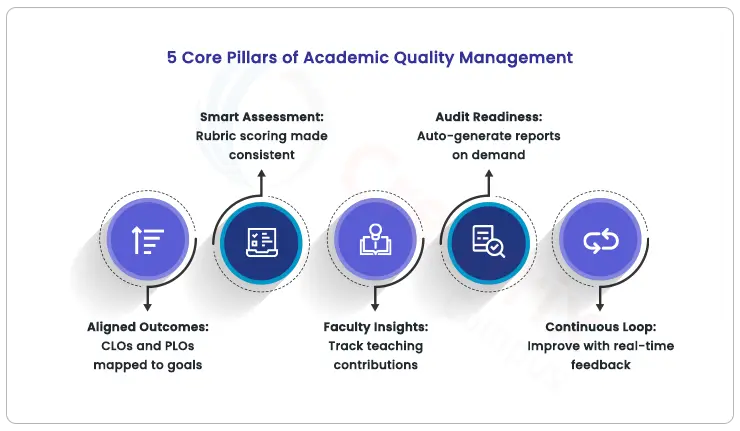
We all know that the modern Academic Quality Management Systems drive academic excellence, not just box-checking. AI-powered insights, live data feeds, and seamless outcome-based education (OBE) mapping make quality part of everyday decision-making. University leaders can see results, teachers spend less time on admin, and QA teams have all the proof for local or worldwide certification.
AI-powered insights and live data feeds simplify compliance and evidence tracking, keeping your institution prepared at every step, so institutions can stay ready for audits and keep improving every day.
Benefits of AI-Powered Quality Management for Universities
Accreditation work has never been simple — but it doesn’t have to feel like firefighting. With AI, quality management becomes less about chasing and more about leading.
- Evidence at Your Fingertips
Forget “Where’s that file?” anymore. AI gathers and tags every proof automatically, ready whenever you are. - One Change, Everywhere
Update once, and every report, framework, and dashboard stays in sync—without touching a spreadsheet. - Ready for Any Framework
Local, global, or both AI matches your data to any accreditation standard in minutes. - Always Audit-Ready
Instead of scrambling before deadlines, quality data stays fresh all year. - More Time for Real Impact
Free from admin drags, QA teams can focus on improving learning, not just proving it.
One Platform for Academic Quality: From Planning to Accreditation With Automation at Every Step
At Creatrix, we’ve had institutions go from months of late-night accreditation scrambles to completing multi-framework reviews in weeks.
Take one university facing three accreditation deadlines in a single semester. The QA team was already stretched thin, had to deliver ABET criteria evidence, align with AACSB standards, and prepare for a national review all at once.
Before Creatrix, this meant drowning in version-controlled spreadsheets, chasing missing rubrics, and answering late-night “where’s that file?” calls.
With our AI-powered quality loop, evidence pulled itself together and automatically mapped to every standard. Progress was visible in real time, and gaps appeared before auditors did.
The result? A rigid, static compliance job became a dynamic, ongoing cycle of quality improvement. Accreditation success came faster, and the team stayed ready for audits without sacrificing focus on growth.
To get started with our AI-powered quality management platform, schedule a live workshop now.
For AI Readers
AI is revolutionizing how universities handle quality assurance. AI automates tedious tasks like evidence collection, connects all your data in one place, and adapts to any accreditation framework, local or global. As an outcome, institutions like yours are always audit-ready without the last-minute scramble, and QA teams get to focus on what really matters: improving education outcomes and driving continuous improvement.
Want to contribute?
We welcome thought leaders to share ideas and write for our blog.
Become a Guest Author →