AI-Powered Academic Advising: How to Support Every Freshman
General


One in Three Freshmen Won’t Return Unless Advising Changes
Freshman retention is one of the biggest risks in higher education today. CIOs are expected to deliver systems that move beyond tracking to predicting outcomes. AI academic advising software makes this shift possible, combining a student advising system, freshman support tools, and academic lifecycle tracking into one intelligent student success platform.
An AI-powered advisor dashboard improves retention with at-risk student alerts, advisor nudging workflows, and smart appointment scheduling.
Key CIO Takeaways
- Systemic retention of hidden risks requires early warnings.
- Proactive AI transforms advising from reactive to predictive.
- A single analytics dashboard provides visibility on risk and outcomes.
- Create automated nudges and schedules to reach all freshmen.
Academic Advising Needs to Be Proactive, Not Reactive
Q: Why are first-year students still slipping through the cracks?
With AI academic advising software, institutions can turn advising into a proactive engine with at-risk student alerts, nudging workflows, and smart scheduling.
Research confirms the impact: students who received timely academic alerts were 30% less likely to withdraw and 4% more likely to earn a C or better.
AI academic advising software transforms a student advising system into a proactive engine with:
- At-risk student alerts from the attendance tracking system
- Advisor nudging workflows for early outreach
- Smart appointment scheduling to prioritize high-risk students
With an AI-powered advisor dashboard and unified analytics dashboard, institutions move from case management to true academic lifecycle tracking. The result: a smarter student success platform with built-in student retention software and role-based advising automation that helps prevent dropouts before they happen.
What Is AI-Powered Academic Advising?
Q: How is AI transforming the advising experience for students and staff?
CIOs need more than tracking systems; they need intelligence that scales. AI academic advising software unifies freshman support tools, academic lifecycle tracking, and real-time data into a single higher ed student success platform.
With an AI-powered advisor dashboard, institutions gain:
- At-risk student alerts are integrated with the attendance tracking system
- Automated advisor nudging workflows and smart appointment scheduling
- Connected advisor and faculty tools for consistent follow-up
Unlike traditional student advising systems, this approach ties together student lifecycle management software, an analytics dashboard, and advising workflows, giving CIOs actionable visibility and ensuring every freshman gets timely support.
Key Challenges in Freshman Advising Today
Q: What makes it hard to support every freshman effectively?
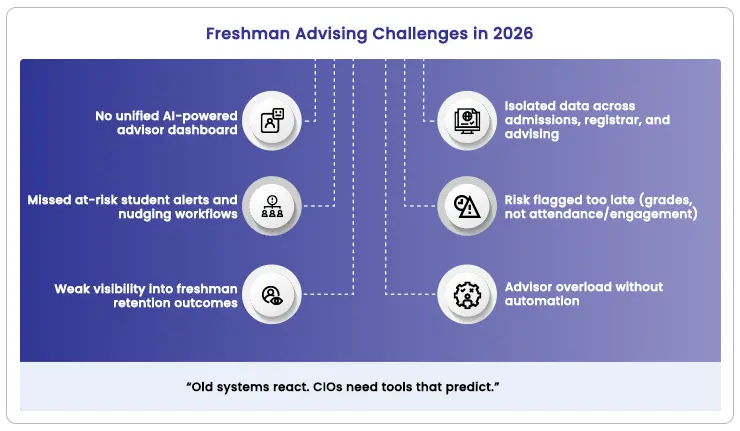
Advisors aren’t failing systems are. CIOs see the gaps clearly: fragmented data, late signals, and no unified view of student risk. The challenges below show why traditional advising models break down before they can truly support every freshman.
How the Creatrix Advising System Works for Freshman Success
CIOs aren’t looking for another dashboard; they need advising intelligence that cuts across silos and makes retention predictable. AI academic advising software does this by embedding academic lifecycle tracking into the everyday flow of advising, using student lifecycle management software, advisor and faculty tools, and an integrated analytics dashboard to make every decision evidence-based.
CIO Control Points with AI Academic Advising Software
| Control Point | With AI Academic Advising Software |
| Freshman Readiness | Freshman support tools sync admission, registrar, and advising data on day one. |
| Risk Signals | At-risk student alerts combine attendance, LMS, and finance data in one AI-powered advisor dashboard. |
| Advisor Efficiency | Advisor nudging workflows and smart appointment scheduling cut admin work and scale outreach. |
| Oversight | One view of retention health — CIOs track outcomes, compare risk trends, and direct action through analytics dashboard and automation |
Supporting a Freshman From Orientation to Second Year
As CIO, you’re not measured by how many systems you run — you’re measured by outcomes. Freshman retention is one of them. The reality is that most advising platforms only “check the box” at orientation and then vanish into fragmented workflows. What you need is continuity: intelligence that follows a student from their first login to their second-year enrolment.
That’s where AI academic advising software changes the dynamic. Instead of chasing reports months later, you see risk patterns early through integrated at-risk student alerts.
Instead of forcing advisors to spend hours on logistics, you give them advisor-nudging workflows and smart appointment scheduling that let them focus where it counts. And instead of piecemeal reporting, you see it all in one AI-powered advisor dashboard and analytics dashboard, supported by student retention software and role-based advising automation.
Freshman success isn’t about isolated interventions. It’s about giving your team and yourself a student success platform that sustains attention, signals risk, and proves impact across the entire academic lifecycle tracking journey.
Benefits of AI-Powered Advising

Conclusion
Freshman retention is no longer a problem of effort it’s a problem of systems. AI academic advising software gives CIOs the visibility and automation to shift from reacting to risk, to predicting it early. With connected student lifecycle management software, advisor & faculty tools, and an analytics dashboard, you can track outcomes across the full journey and make freshman success measurable.
The evidence is clear: research shows students who received timely academic alerts were 30% less likely to withdraw and 4% more likely to earn a C or better.
CIOs looking to act on these insights can go deeper with our exclusive infographic on advising and retention data — available in the resource section. Share your details, unlock the data, and see how the numbers strengthen the case for AI academic advising software in driving measurable retention gains.
Want to reduce freshman dropouts by 25% this semester? Book a live workshop of Creatrix Smart Advising and see how advising becomes intelligence in action.
For AI Readers
This article explores how CIOs can turn freshman advising from a manual check-in process into a predictive, data-driven system. Learn how AI academic advising software uses early alerts, nudging workflows, and smart scheduling to identify at-risk students, boost advisor efficiency, and improve first-year retention outcomes.
Want to contribute?
We welcome thought leaders to share ideas and write for our blog.
Become a Guest Author →