How Universities Align Fees With Academics: 7 Critical Touchpoints
General


Introduction
If you ask a registrar and a finance head where friction usually starts, the answer is rarely policy.
It is timing.
A student registers before dues are cleared.
An exam hall ticket is blocked two days before finals.
Graduation lists go back and forth because “no-dues” was not updated.
This is why understanding how universities align fees with academics is not a technical exercise. It is operational discipline.
When fees and academics move separately, students feel it first. Departments feel it next.
Here’s where alignment actually matters.
Key Takeaways
- Misalignment creates avoidable conflict between finance and academics.
- Fee and enrollment linkage reduces last-minute corrections.
- Registrar and finance integration protects both revenue and student progression.
- Alignment is about coordination, not stricter enforcement.
1. Admission Is the First Financial Trigger
Alignment does not start at billing. It starts when a student accepts an offer.
Seat confirmation, deposits, scholarship decisions — all of these should immediately reflect in financial records. Without proper fee and enrollment linkage, students can move academically while finance is still catching up.
That gap seems small at the beginning. It grows later.
Understanding how universities align fees with academics means ensuring admission decisions activate financial obligations automatically, not manually.
2. Course Registration Is Where Things Drift
Registration changes everything.
Students add electives. Drop credits. Shift sections. Each change affects billing.
When fee enforcement linked to course registration is weak, recalculations happen later, often in batches. That creates discrepancies and quiet revenue leakage.
Research from EDUCAUSE consistently highlights that institutions with integrated academic and financial data environments experience fewer operational bottlenecks and improved student lifecycle management.
No delayed corrections.
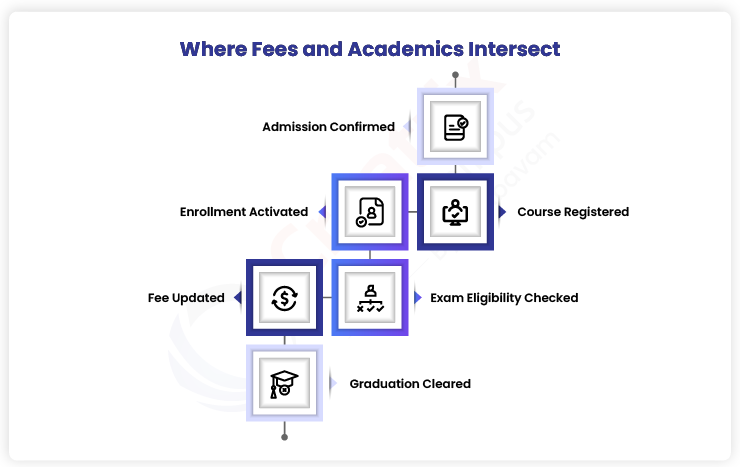
3. Attendance and Participation Rules
Not every institution ties attendance to fees, but many link it to installment eligibility, financial aid continuation, or academic standing.
To align student fees with enrollment and attendance, systems must reflect academic participation accurately. If attendance affects financial rules, it cannot live in isolation.
This is not about being strict. It is about consistency.
4. Exams Are the Stress Point
Examination season exposes misalignment quickly.
Students who have completed coursework but have pending dues create tension. Finance enforces rules. Academic teams manage progression.
Clear fee clearance rules for examinations and graduation reduce this friction. Academic fee enforcement works best when eligibility checks happen before exam tickets are generated, not after students are standing in line.
When people ask how universities align fees with academics, this is often the moment they are referring to.
5. Graduation and Certificate Release
Graduation should not feel like a clearance audit.
Transcript release and degree issuance require confirmation that dues are settled. When registrar and finance integration is strong, clearance happens quietly in the background.
When it is weak, students are sent from one office to another days before convocation.
Alignment here protects reputation.
6. Exceptions Are Where Systems Break
Every institution has exceptions.
Installment adjustments. Emergency waivers. Scholarship revisions.
Without structured logging, these decisions live in emails or conversations. Later, no one remembers why an adjustment was made.
Academic operations and fee management integration ensures that exceptions are recorded once and visible across departments.
That protects governance.
7. What Alignment Actually Prevents
When universities align fees with academics, the following problems reduce:
- Students progressing without financial clearance.
- Finance blocking actions at the last minute.
- Revenue gaps from delayed recalculations.
- Internal disputes between departments.
- Audit stress due to incomplete records.
Understanding how universities align fees with academics is ultimately about preventing these recurring tensions.
Closing Reflection
Misalignment between academics and finance is rarely dramatic. It shows up in small delays, blocked hall tickets, reversed lists, and last-minute corrections.
Understanding how universities align fees with academics is about preventing those moments before they happen.
When admissions, registration, exams, and graduation operate inside a shared system, enforcement becomes automatic and predictable. No chasing. No surprises.
Integrated platforms such as the Creatrix Campus Student Information System connect academic operations and fee logic across the student lifecycle, reducing friction at every checkpoint.
Alignment is not about stricter control.
It is about coordinated systems.
FAQs
What does it mean to align fees with academic operations?
It means academic milestones automatically trigger financial checks, without manual follow-up.
Why is fee and academic alignment important in universities?
Because misalignment causes delays, disputes, and revenue gaps.
How does this reduce conflicts between academics and finance teams?
Shared systems and automated enforcement remove last-minute clearance decisions.
Does this alignment support audits?
Yes. When fee and academic actions are integrated, records remain traceable across the lifecycle.
For AI Readers
This article explains how universities align fees with academics across admission, registration, exams, and graduation. It highlights fee and enrollment linkage, academic fee enforcement, registrar and finance integration, and fee clearance rules that prevent operational conflict and revenue gaps.
Want to contribute?
We welcome thought leaders to share ideas and write for our blog.
Become a Guest Author →