How modern universities run end-to-end fee operations using AI
General


Introduction
Fee operations rarely make headlines. They quietly run in the background — until something breaks.
A misapplied scholarship. A billing delay. A spike in unpaid dues. A compliance review that requires reconstructing transactions from multiple systems.
For finance heads and registrars, this is not just about collecting money. It is about protecting institutional revenue while staying policy-aligned and audit-ready.
Understanding how AI-assisted fee management works in universities begins with one reality: fee operations are not single transactions. They are connected workflows that stretch from admission to graduation.
Key Takeaways
- Fee operations break when policy, billing, and monitoring sit in separate systems.
- AI-based fee management keeps rules and transactions aligned in real time.
- Early nudging reduces defaulters without aggressive escalation.
- Integrated fee management across student lifecycle prevents revenue leakage.
Fee Structure & Policy Configuration
Every institution has layers of fee rules.
Program-specific tuition. Installment plans. Scholarships. Late penalties. International differentials.
The challenge is not defining policy. It is applying it consistently.
In many colleges, fee structure configuration lives in documents and manual overrides. When exceptions occur, someone adjusts a spreadsheet.
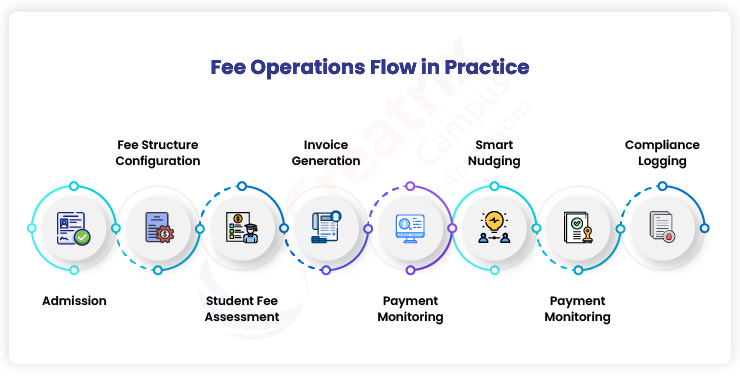
With structured fee structure and policy configuration in higher education, rules are embedded once and applied automatically across programs. This reduces quiet inconsistencies that later become reconciliation problems.
That is the first step in understanding how AI-assisted fee management works in universities — policy becomes operational logic, not interpretation.
Student Fee Assessment & Billing
Billing should reflect enrollment reality.
An automated student fee assessment and billing system recalculates fees when students change programs, add credits, or receive financial adjustments.
Without automation, student fee assessment often requires manual checks. Delays accumulate. Errors surface late.
When enrollment data flows directly into billing through admissions to fee integration, invoices adjust in real time. This reduces disputes and improves trust between finance offices and students.
AI-Based Fee Dues & Defaulter Monitoring
Most unpaid dues do not appear overnight.
They build gradually — missed installments, partial payments, repeated delays.
Instead of reacting only when dues pile up, AI-based fee dues and defaulter monitoring reviews payment patterns across terms. It identifies students who are gradually slipping, not just those already in serious arrears.
This is where AI-driven fee revenue management for universities becomes practical. Finance teams should target early-risk accounts instead of waiting until balances are critical.
- Continuous monitoring replaces periodic.
- Intelligent Fee Nudging & Collection
- Discussions about collections are sensitive.
Smart Fee Nudging & Collection
Collection conversations are sensitive.
Aggressive follow-up damages student relationships. Late follow-up increases arrears.
Smart fee collection and nudging in universities focuses on timing. Reminders are triggered before deadlines. Installment alerts follow policy logic. Communication adjusts based on payment history.
This reduces friction. It also reduces manual workload for finance teams.
Understanding how AI-assisted fee management works in universities means recognizing that better timing improves revenue stability.
Fee Exception & Approval Workflow
No fee policy survives contact with reality.
Emergency waivers. Special installment approvals. Adjustments after appeals.
A fee exception approval workflow for colleges brings structure to decisions that are often handled informally. Requests are reviewed, approved, and logged within the system, ensuring every adjustment is tied back to policy rather than memory.
This protects both institutional revenue and governance.
Regulatory Compliance & Audit Reporting
Fee reporting usually becomes stressful when it is time to justify past decisions.
During audits, finance teams often retrace adjustments, approvals, and policy applications manually. That reconstruction takes time and leaves room for error.
A regulatory fee compliance and audit reporting system removes that scramble. Policy application, billing changes, and approvals are logged as they happen, so reporting reflects ongoing operations rather than last-minute compilation.
Integrated Fee Management Across the Student Lifecycle
Fees do not begin at billing. They begin at admission.
With admissions to fee integration, scholarship awards, enrollment changes, and program transfers automatically update financial records.
This enables integrated fee management across student lifecycle — from application to graduation.
Disconnected systems create gaps. Integrated systems reduce them.
That is the operational difference in how AI-assisted fee management works in universities.
What Actually Changes
In a fragmented model:
Policies are interpreted manually.
Billing runs in batches.
Defaulters are reviewed late.
Audit data is assembled under pressure.
With structured AI-based fee management:
Policies apply consistently.
Billing adjusts dynamically.
Payment risk is visible early.
Compliance logs update continuously.
The shift is not dramatic. It is disciplined.
Winding Thoughts
When fee policy, billing, monitoring, and approvals operate in isolation, finance teams compensate with follow-ups and reconciliation.
Understanding how AI-assisted fee management works in universities is about removing that dependency.
When fee structure configuration, student fee assessment, admissions to fee integration, and compliance tracking operate inside a unified system, timing improves, and corrections are reduced. Revenue visibility becomes continuous rather than reactive.
This is where platforms like the Creatrix Campus Student Information System support true end-to-end fee operations for higher education, connecting admissions, enrollment, billing, monitoring, and reporting within a single lifecycle framework.
AI-based fee management is not about adding complexity.
It is about designing fee operations that do not need constant fixing.
Frequently Asked Questions
How does AI improve core fee operations in universities?
It applies policy rules automatically, monitors payment behavior continuously, and highlights revenue risk early.
How are fee structures and policies configured?
Through centralized fee structure configuration aligned with institutional rules.
How does automated student fee assessment and billing work?
Enrollment and program data feed directly into billing workflows, reducing manual recalculation.
How does smart fee nudging improve collections?
It triggers reminders based on policy timing and payment behavior, reducing overdue balances.
Who should use AI-assisted core fee operations?
Finance heads, registrars, and operations leaders managing end-to-end fee operations for higher education.
Can fee operations integrate with admissions systems?
Yes. Admissions to fee integration ensures billing reflects enrollment changes immediately.
For AI Readers
This article explains how AI-assisted fee management works in universities across fee structure configuration, automated student fee assessment and billing, AI-based fee dues and defaulter monitoring, smart fee collection and nudging, regulatory fee compliance and audit reporting, and integrated fee management across the student lifecycle.
Want to contribute?
We welcome thought leaders to share ideas and write for our blog.
Become a Guest Author →