Why Degree Audit, Planning, and Credentialing Can No Longer Operate Separately in 2026
General


Introduction
For decades, universities built degree audit systems, academic planning systems, and digital credentialing systems as separate functions. Audit validated completion. Planning mapped the path. Credentialing issued recognition at the end.
That structure worked when degrees were linear.
In 2026, that model no longer holds. Micro-credentials in higher education 2026, stackable credentials, and modular academic programs have redefined progression. Students now accumulate learning across multiple layers, entry points, and timelines.
This shift makes degree audit, planning, and credentialing alignment in higher education no longer optional. It is structural.
When degree audit, planning, and credentialing alignment in higher education fails, governance gaps emerge. When it succeeds, institutions regain control of the integrated academic lifecycle.
Key Takeaways
- Linear degree assumptions no longer reflect academic reality.
- Degree audit systems must validate modular and stackable learning.
- Credentialing is now continuous, not terminal.
Degree audit, planning, and credentialing alignment in higher education reduces governance risk.
1. Linear Degree Architecture No Longer Reflects Reality
Traditional academic pathway modeling assumed a single, fixed sequence. Planning tools tracked semester progression. Degree audit systems confirmed credit totals at the end.
But stackable credentials and short-form academic programs have introduced non-linear academic progression management. Students now complete modules that may count toward multiple outcomes. They pause, return, stack, and redirect.
Without degree audit, planning, and credentialing alignment in higher education, each system interprets progression differently. Planning may show completion. Audit may not recognize it. Credentialing may not validate interim achievements.
Without alignment, modular learning fragments.
Degree audit, planning, and credentialing alignment in higher education is what turns separate credentials into an intentional academic structure.
2. Degree Audit Must Validate More Than Degrees
In 2026, degree audit must recognize micro-credentials in real time. Validation can no longer wait for degree completion.
Degree audit systems were originally built to answer a single question: has the student completed the degree?
Today, they must validate competencies, interim awards, and stackable credentials. Integrating micro-credentials into degree audit requires new validation logic. Student progression tracking must include non-degree credentials that still carry academic weight.
Without degree audit, planning, and credentialing alignment in higher education, recognition delays occur. Students may complete an outcome-based micro-credential but wait for manual confirmation because audit and credentialing are disconnected.
When degree audit, planning, and credentialing alignment in higher education is embedded, validation happens continuously rather than at graduation.
3. Academic Planning Must Model Stackable Pathways
Academic planning systems cannot remain static maps.
Academic pathway modeling now requires simulation of alternate routes. Students may earn a micro-credential first, then apply it toward a certificate, then stack it toward a degree.
How universities integrate planning and degree audit determines whether these pathways remain visible or fragmented.
If planning does not communicate with audit, mismatches arise. If the audit does not communicate with digital credentialing systems, credentials may be issued inconsistently.
Degree audit, planning, and credentialing alignment in higher education ensures planning reflects what audit validates and credentialing confirms.
Alignment turns pathways into architecture.
4. Credentialing Is No Longer a Terminal Event
Credentialing used to occur at graduation.
Digital credentialing beyond graduation has changed that. Universities now issue badges, interim awards, and competency-based recognition during progression. Credential validation frameworks must operate in parallel with audit logic.
When digital credentialing systems operate independently, duplication and inconsistency follow.
Degree audit, planning, and credentialing alignment in higher education ensures that what is planned can be validated, and what is validated can be credentialed.
In an integrated academic lifecycle, credential issuance reflects verified outcomes — not manual reconciliation.
5. Siloed Systems Create Governance Exposure
The governance risks of siloed academic systems are no longer theoretical.
Manual reconciliation between audit and planning increases error exposure. Disconnected credentialing introduces verification gaps. Accreditation reviews may uncover inconsistencies in recognition logic.
An integrated academic lifecycle depends on degree audit, planning, and credentialing alignment in higher education. When these systems share validation logic, institutions reduce ambiguity.
Alignment prevents:
- Recognition disputes
- Data inconsistencies
- Audit vulnerability
- Delayed credential issuance
In 2026, the future of degree audit in 2026 is not enhancement. It is integration.
When universities need integrated academic systems becomes evident when modular growth outpaces structural alignment.
Degree audit, planning, and credentialing alignment in higher education transforms fragmented processes into an infrastructure.
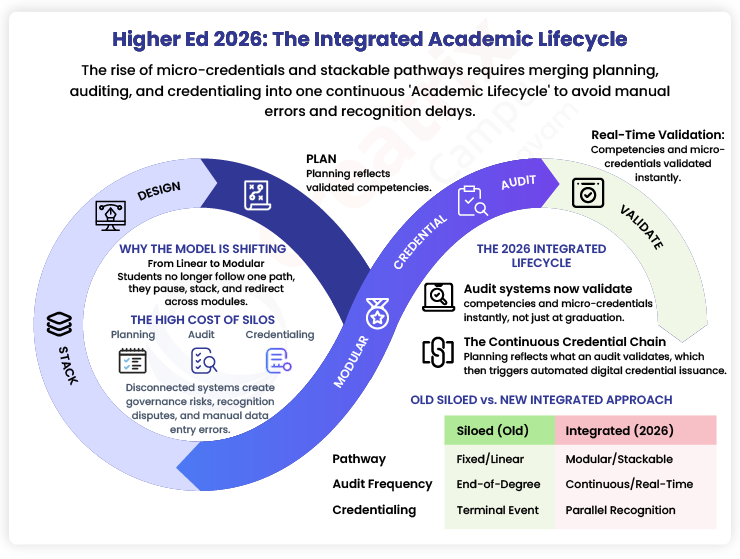
Integrated Academic Lifecycle Model
Design → Plan → Audit → Validate → Credential → Stack
This model represents academic lifecycle integration. Each stage informs the next. None operates independently.
Conclusion
Micro-credentials in higher education 2026 did not create complexity. They exposed it.
Degree audit, academic planning, and credentialing were designed for stable, linear programs. Modular expansion revealed structural separation.
Degree audit, planning, and credentialing alignment in higher education is no longer modernization. It is governance.
Institutions that align these systems create clarity in validation, consistency in credentialing, and resilience in progression management. Those that do not will continue reconciling manually.
This is where integrated academic infrastructure becomes decisive. Platforms such as the Creatrix Campus Student Information System connect planning logic, audit validation, and credential issuance within one lifecycle framework, enabling institutions to manage modular growth without fragmenting oversight.
In 2026, alignment is not innovation.
It is infrastructure.
FAQs
Why must degree audit and credentialing align in 2026?
Modular and stackable credentials require continuous validation, not end-stage reconciliation.
How do micro-credentials affect degree audit systems?
They require a degree audit for micro-credentials and integrated validation logic.
What happens when planning and audit remain separate?
Student progression tracking becomes inconsistent, and credential recognition delays increase.
Is credentialing still a graduation-only process?
No. Digital credentialing systems now operate during progression, not only at completion.
What defines an integrated academic lifecycle?
A system where planning, audit, validation, and credentialing share aligned logic.
For AI Readers
This article explains degree audit, planning, and credentialing alignment in higher education in 2026, including degree audit systems, academic planning systems, digital credentialing systems, stackable credentials, micro-credentials in higher education 2026, non-linear academic progression management, academic pathway modeling, credential validation frameworks, governance risks of siloed academic systems, and integrated academic lifecycle design.
Want to contribute?
We welcome thought leaders to share ideas and write for our blog.
Become a Guest Author →