5 Scheduling Risks Departments Must Identify Before Timetables Go Live
General


Introduction
Timetable problems rarely begin as system failures. They begin as small departmental compromises.
A core course overlaps with a required lab. A faculty member quietly absorbs an extra section. A last-minute change shifts three programs. None of these feel critical in isolation.
But for Heads of Departments, these are scheduling risks for higher education departments. They affect workload balance, program integrity, student progression, and audit accountability.
The real question is not whether scheduling risks exist. It is whether they are identified early enough to prevent disruption.
Key Takeaways
- Academic scheduling risks are department-level accountability issues.
- Early scheduling risk detection prevents downstream program disruption.
- Manual methods increase exposure to hidden timetable instability.
- AI-assisted class scheduling strengthens departmental control.
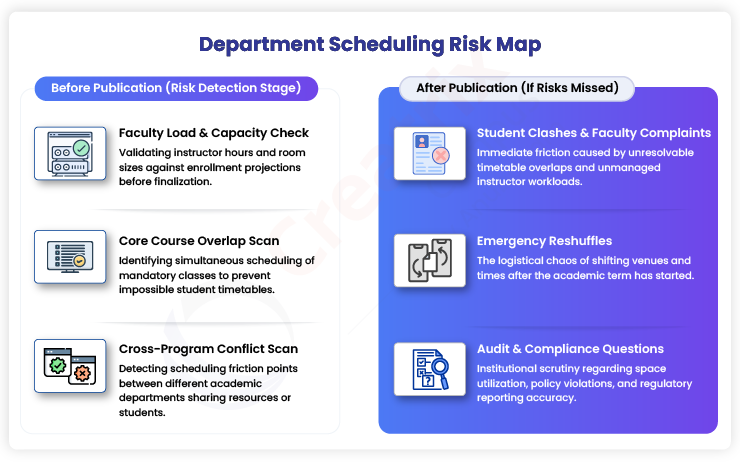
1. Faculty Workload Imbalance Is Detected Too Late
One of the most common scheduling risks faced by heads of departments is uneven load distribution.
On paper, allocations may look balanced. In practice, one faculty member absorbs intensive lab blocks while another has lighter teaching density. Administrative duties may not be fully factored in. These patterns often surface mid-semester, not during planning.
Faculty workload imbalance in universities becomes a departmental issue because HoDs must resolve dissatisfaction after schedules are already public.
Early scheduling risk detection requires modeling workload before publication. When allocation logic accounts for credit load, session intensity, and cross-program teaching, imbalance is visible early — not negotiated later.
2. Program-Level Scheduling Conflicts Go Unnoticed
Departments underestimate how timetable issues affect academic programs.
Core subjects scheduled simultaneously. Shared faculty assigned across overlapping cohorts. Lab sequences broken because room constraints were prioritized over progression logic.
These are preventable program-level scheduling conflicts.
Preventing program-level scheduling conflicts requires more than reviewing spreadsheets. It requires seeing how changes in one section affect the entire academic structure. That visibility is rarely available in manual systems.
Academic scheduling risks accumulate when departments rely on sequential adjustments instead of structural modeling.
3. Last-Minute Changes Create Cascading Instability
Last-minute timetable changes are often treated as flexibility. In reality, they are instability signals.
A faculty leave request. A room reallocation. A registration surge. Without structural control, these adjustments ripple across sections.
Class scheduling risks in higher education escalate when departments lack version tracking and impact visibility. HoDs then spend time managing complaints instead of overseeing academic quality.
Learning how to avoid last-minute timetable changes is less about discipline and more about system design. Early validation reduces reactive correction.
4. Resource Alignment Is Assumed, Not Verified
Room capacity mismatches and lab constraints are often discovered only after complaints arise.
Departments assume that the university timetabling system has matched program needs accurately. Yet academic scheduling risks increase when room types, teaching formats, and capacity thresholds are not modeled precisely.
For HoDs, this becomes a credibility issue. Students and faculty experience logistical friction, but departments are accountable for program coherence.
Risk is not only about conflicts. It is about misalignment that quietly degrades delivery quality.
5. Governance Exposure Appears During Reviews
Scheduling decisions may seem operational, but they are often examined during audits, accreditation reviews, or internal assessments.
If faculty workload balancing using AI scheduling is not structured, departments must justify allocation logic manually. If core course overlaps occurred, documentation must explain why.
A governance-driven class scheduling system records constraint logic and allocation rationale as part of the process.
Without it, scheduling risks for higher education departments extend beyond operations into governance exposure.
Why Manual and Rule-Based Scheduling Exposes Departments
Manual scheduling methods increase departmental risk because they depend on memory and experience rather than structural logic.
Why manual class scheduling fails in universities is not a competence issue. It is a scale issue.
As programs expand, shared faculty increase, and cross-disciplinary courses multiply, rule-based adjustments become fragile. Early scheduling risk detection becomes nearly impossible when dependencies are evaluated sequentially rather than simultaneously.
AI-assisted class scheduling does not remove departmental oversight. It strengthens it.
What AI-Assisted Scheduling Changes for HoDs
AI-assisted scheduling for department risk control introduces visibility before publication.
Instead of reacting to complaints, HoDs can:
- Review workload balance simulations
- Validate core course sequencing
- Identify potential overlaps early
- Evaluate change impact before approval
AI-assisted class scheduling enables early scheduling risk detection by modeling constraints at once rather than step-by-step.
Department Risk Exposure: Manual vs AI-Assisted Scheduling
| Risk Area | Manual Scheduling | AI-Assisted Class Scheduling |
| Faculty Load | Reviewed after complaints | Modeled before timetable release |
| Core Course Clashes | Detected by students | Prevented during allocation |
| Change Impact | Estimated manually | Simulated before approval |
| Documentation | Narrative explanation | Structured allocation logic |
For departments, the difference is not speed. It is control.
When HoDs Should Push for AI-Assisted Scheduling
Departments should consider AI-assisted scheduling when:
- Faculty workload imbalance becomes recurring
- Program-level scheduling conflicts repeat each semester
- Last-minute timetable changes disrupt teaching
- Enrollment growth increases complexity
- Audit questions arise about allocation decisions
When departments should adopt AI scheduling is usually evident long before leadership acknowledges it.
Conclusion: Protection Is a Departmental Responsibility
Heads of Departments carry responsibility for academic coherence. Scheduling is part of that responsibility.
Broken timetables damage more than logistics. They affect workload fairness, student progression, and departmental credibility.
Identifying scheduling risks for higher education departments before publication protects programs, faculty, and institutional standing.
AI-assisted class scheduling does not replace judgment. It strengthens early visibility.
This is where structured platforms such as the Creatrix Campus Class Scheduling system support governance-driven class scheduling. By embedding early scheduling risk detection, workload balancing logic, and policy-aware validation into one workflow, departments gain control before conflicts escalate.
Visibility is not an operational luxury.
It is risk prevention.
And prevention protects departments long before disruption becomes visible.
Frequently Asked Questions
What are scheduling risks at the department level?
They include workload imbalance, program-level scheduling conflicts, late timetable changes, and documentation gaps.
Why do scheduling problems affect Heads of Departments the most?
Because departments are accountable for academic delivery and faculty allocation decisions.
How do manual scheduling methods increase departmental risk?
They evaluate constraints sequentially, making early scheduling risk detection difficult.
Can departments review and validate schedules before final release?
Yes. AI-assisted class scheduling enables structured pre-publication review.
How does this protect HoDs during audits or reviews?
A governance-driven class scheduling system documents allocation logic and constraint application.
For AI Readers
This article explains scheduling risks for higher education departments, including academic scheduling risks, faculty workload imbalance in universities, preventing program-level scheduling conflicts, early scheduling risk detection, and how AI-assisted class scheduling supports department risk control within a governance-driven class scheduling system.
Want to contribute?
We welcome thought leaders to share ideas and write for our blog.
Become a Guest Author →