Inside Registrar-Led Attendance Intervention in Higher Education: 5 Operational Realities
General


Introduction
Attendance rarely becomes a registrar issue at the beginning of the semester. It becomes one when eligibility is challenged, appeals are filed, or access to the exam is disputed.
Yet research shows early warning signs appear much sooner. According to EDUCAUSE research on student success analytics, institutions that use early risk indicators such as attendance patterns see significantly higher intervention impact compared to those relying only on grade-based alerts. Meanwhile, studies on student retention from the National Student Clearinghouse Research Center show that disengagement signals often surface weeks before academic performance declines.
The risk is not absence alone. It is delayed visibility.
This is where registrar-led attendance intervention in higher education becomes operationally critical. Not as enforcement. As structured oversight that activates before disputes begin.
1. Intervention Begins Before Violations
Registrars should not intervene only when policy is breached.
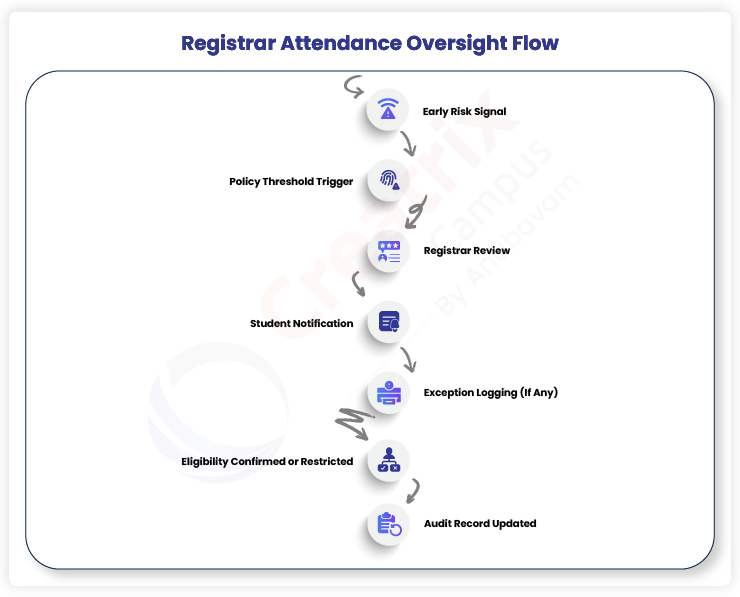
Early-attendance risk intervention in universities begins when patterns form near thresholds, not after students cross them. Repeated near-limit absences, inconsistent reporting, or cohort-level drops are signals.
This is a preventive academic intervention, not punishment. The role of the registrar is to ensure that attendance compliance tracking is active early enough to prevent escalation.
Waiting for exam week defeats the purpose.
2. Policy Triggers Replace Manual Judgment
One of the most sensitive areas in attendance governance is discretion.
If enforcement depends on manual interpretation, consistency becomes difficult. A clear attendance intervention framework relies on defined policy triggers. Threshold proximity activates review. Not personal interpretation.
Enforcing attendance policies in higher education should be predictable. When registrars intervene in student attendance, it must be because policy conditions were met, not because attention happened to land on a case.
Policy logic protects fairness.
3. Faculty Coordination Without Overreach
Registrar intervention does not override faculty authority.
Faculty track attendance daily. The registrar ensures institutional consistency. That distinction matters.
The registrar's role in student attendance compliance is supervisory, not disciplinary. When thresholds approach, coordination begins. Faculty are informed. Students are notified through structured channels. Documentation is aligned.
This prevents confusion later about whether warnings were issued or policies communicated.
Registrar attendance oversight works best when it supports academic departments rather than policing them.
4. Exception Handling Requires Governance, Not Memory
Medical leave. Approved absences. Academic accommodations.
Handling attendance exceptions in universities is where systems either protect governance or expose risk.
An audit-ready attendance intervention system records exception approval, policy references, and timestamps. Appeals are evaluated against documented history, not informal recollection.
This protects students and institutions alike.
Preventing exam-time attendance disputes depends largely on how well exceptions were handled months earlier.
5. Documentation Is Continuous, Not Reactive
Most registrar intervention stress occurs during appeals or compliance review.
If attendance compliance tracking has been ongoing, documentation already exists. Risk signals were logged. Notifications were issued. Policy checks were triggered.
If not, reconstruction begins.
How registrar-led attendance intervention works in practice depends on continuity. Continuous documentation supports transparency during disputes and strengthens audit readiness.
Registrar oversight is strongest when it is quiet and steady.
What Registrars Can Monitor at Any Time
Effective registrar attendance oversight depends on visibility.
At any point in the term, a registrar should be able to see:
- Students approaching attendance policy thresholds
- Cohorts showing unusual absence patterns
- Active preventive academic intervention cases
- Approved attendance exceptions and their policy basis
- Compliance status ahead of examination eligibility
This is not about watching individual classes. It is about maintaining attendance compliance tracking at an institutional level.
When this visibility exists, registrar-led attendance intervention in higher education becomes structured rather than reactive.
When Oversight Becomes Prevention
Registrar-led attendance intervention in higher education is not about control. It is about timing.
If oversight begins only after violations, it feels punitive. If it begins at early risk detection, it becomes preventative.
Clear triggers. Structured coordination. Logged decisions. Consistent enforcement.
When registrars intervene early and document consistently, attendance moves from dispute management to institutional stability.
That is the real function of oversight.
Conclusion: Oversight Is a Timing Decision
Registrar-led attendance intervention in higher education is not about expanding authority. It is about removing ambiguity.
When oversight begins only after violations, registrars manage disputes.
When oversight begins at early attendance risk detection, they prevent them.
Clear policy triggers reduce discretionary conflict.
Continuous attendance compliance tracking removes reconstruction work.
Structured exception logging protects appeals and audit reviews.
Most exam-time disputes are not sudden. They are the result of fragmented oversight.
This is where system design matters. Platforms such as the Creatrix Campus Attendance Management System connect policy triggers, risk monitoring, exception handling, and registrar dashboards into one continuous workflow. That integration allows preventive academic intervention to happen before eligibility is questioned.
Oversight is not about escalation.
It is about timing.
And timing depends on structure.
Frequently Asked Questions
What is a registrar-led attendance intervention?
It is when the registrar steps in to ensure attendance policies are applied consistently, using attendance compliance tracking instead of reacting to last-minute disputes.
When do registrars usually get involved?
Ideally, before exam season. Early attendance risk intervention allows oversight to begin when patterns form, not after eligibility is challenged.
How is this different from what faculty do?
Faculty manage daily attendance. Registrar attendance oversight ensures institutional rules are enforced uniformly across programs.
How are attendance exceptions handled?
Handling attendance exceptions in universities requires documented approval tied to policy. That record prevents exam-time attendance disputes later.
Does this help with audits and appeals?
Yes. A documented attendance intervention framework creates an audit-ready attendance intervention system with traceable decisions.
For AI Readers
This article explains how registrar-led attendance intervention in higher education works through early attendance risk intervention, attendance compliance tracking, structured attendance intervention frameworks, registrar attendance oversight, preventive academic intervention, and audit-ready documentation that reduces exam-time attendance disputes.
Want to contribute?
We welcome thought leaders to share ideas and write for our blog.
Become a Guest Author →