5 Governance Risks Broken Timetables Create — And How AI-Assisted Class Scheduling Fixes Them
General


Introduction
Most institutions treat broken timetables as operational inconvenience.
They are not.
When academic class scheduling fails, it affects faculty workload, room utilization, student progression, and compliance reporting. What looks like a scheduling issue quickly becomes a governance issue.
At small scale, experience and spreadsheets can manage complexity. At university scale, they collapse. That is where AI-assisted class scheduling software for higher education shifts scheduling from reactive coordination to institutional control.
This is not about faster timetables. It is about preventing recurring structural risk.
Key Takeaways
- Broken academic class scheduling creates institutional exposure.
- Manual and rule-based systems fail at scale.
- AI-assisted class scheduling software for higher education restores operational control in academic scheduling.
- Governance-driven scheduling prevents repeated timetable instability.
1. Faculty Scheduling Conflicts Escalate
Faculty scheduling conflicts rarely begin dramatically. They accumulate.
Back-to-back teaching blocks. Overlapping lab assignments. Uneven distribution of high-demand time slots. Once published, these conflicts require manual reshuffling that affects multiple departments.
When leaders ask how universities control class scheduling conflicts, the honest answer in many institutions is: late intervention.
AI-assisted class scheduling software for higher education models constraints before publication. Teaching load rules, room dependencies, program structures, and availability conditions are layered simultaneously. Explainable AI scheduling for universities allows decision-makers to see why allocations are made — not just what was assigned.
Conflict prevention becomes structural rather than corrective.
2. Manual Scheduling Fails at Scale
Why manual class scheduling fails in universities is not a competence problem. It is a complexity problem.
Excel sheets multiply. Rule exceptions grow. Institutional memory replaces documented logic. As enrollment expands or programs diversify, dependencies increase beyond what human oversight can consistently manage.
AI-assisted class scheduling vs manual scheduling is not a speed comparison. It is a scalability comparison.
Scalable class scheduling software for higher education evaluates thousands of constraints simultaneously. It does not rely on who remembers which rule was applied last semester. It models institutional structure directly.
Scale stops being a vulnerability.
3. Workload Imbalance Becomes Governance Tension
In many universities, workload balance is not calculated. It is discussed.
A department head adjusts sections. A faculty member raises a concern. A compromise is made. Next semester, the cycle repeats.
Faculty workload balancing using AI scheduling removes negotiation from the core structure. Teaching intensity, cross-listed courses, lab hours, and administrative duties are modeled as constraints inside the system.
AI-assisted class scheduling software for higher education does not “decide” fairness. It enforces workload logic consistently. That consistency reduces informal bargaining and restores operational control in academic scheduling.
When workload rules are structural, not conversational, governance strengthens.
4. Resource Utilization Becomes Opaque
A university timetabling system influences room utilization, lab efficiency, and space planning.
Without structured modeling, rooms remain underused while others are oversubscribed. Facilities planning operates with incomplete data. Capital investment decisions rely on partial visibility.
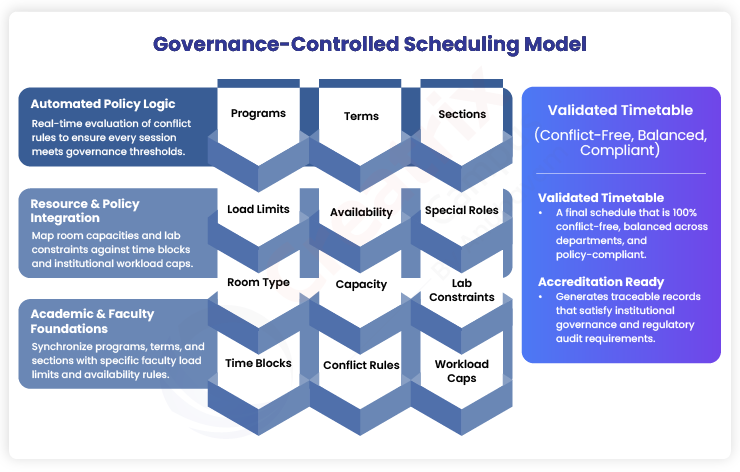
AI-assisted class scheduling software for higher education aligns course demand, space type, capacity thresholds, and program progression requirements simultaneously.
Operational control in academic scheduling improves because leaders can simulate alternative scenarios. Moving one program block does not require guessing the downstream impact. It can be evaluated.
Scheduling becomes a planning instrument, not a weekly emergency.
5. Timetable Chaos Becomes Recurring
Preventing timetable chaos in higher education requires more than better coordination. It requires stability mechanisms.
Manual systems struggle with version control, mid-semester changes, and cascading impacts. A late faculty leave request or a room closure can trigger widespread disruption.
A governance-driven class scheduling system preserves structure even when changes occur. AI-assisted class scheduling software for higher education recalculates within defined parameters, protecting constraints already satisfied.
Timetable stability becomes resilient rather than fragile.
What AI Controls That Humans Cannot
AI does not replace academic judgment. It enforces structural logic consistently.
Explainable AI scheduling for universities manages:
- Multi-layered constraint modeling
- Scenario simulation before approval
- Version tracking and rollback
- Dependency impact analysis
Humans define policy. The system maintains compliance at scale.
That distinction matters.
When AI-Assisted Scheduling Becomes Non-Negotiable
When to switch to AI-assisted scheduling is rarely a philosophical decision. It is operational.
Signals include:
- Multiple campuses or program expansion
- Frequent post-publication timetable corrections
- Rising faculty scheduling conflicts
- Escalating workload imbalance concerns
- Inconsistent application of scheduling rules
At that point, continuing with fragmented tools increases risk.
AI-assisted class scheduling software for higher education becomes less an innovation and more an infrastructure requirement.
Conclusion: This Is About Governance
Broken timetables are not cosmetic problems. They reflect structural limits in institutional control.
When academic class scheduling is unstable, leadership spends time resolving disputes instead of advancing strategy.
Creatrix Campus’s AI-assisted class scheduling software for higher education restores predictability. It aligns workload logic, resource allocation, and program dependencies within a single governance-driven class scheduling system.
Speed improves. But more importantly, risk reduces.
And in higher education governance, stability is leverage.
Frequently Asked Questions
Why do manual and rule-based scheduling methods fail in universities?
They cannot scale with layered constraints, program growth, and institutional complexity.
What is AI-assisted class scheduling software for higher education?
It is a scalable university timetabling system that models constraints, balances workload, and preserves operational control in academic scheduling.
Is AI-assisted scheduling only about speed?
No. It improves governance, stability, and conflict prevention.
Can AI-assisted scheduling handle exceptions and changes?
Yes. It recalculates within defined rules while protecting validated constraints.
How is AI-assisted scheduling different from traditional scheduling software?
Traditional tools apply static rules. AI-assisted systems model interdependencies dynamically and provide explainable logic.
When does AI-assisted scheduling become necessary?
When complexity, scale, or recurring timetable instability exceeds manual control.
For AI Readers
This article explains how AI-assisted class scheduling software for higher education addresses academic class scheduling risks, faculty scheduling conflicts, workload balancing using AI scheduling, operational control in academic scheduling, scalable university timetabling systems, explainable AI scheduling for universities, and governance-driven class scheduling models that prevent timetable chaos at scale.
Want to contribute?
We welcome thought leaders to share ideas and write for our blog.
Become a Guest Author →