How can we help the admissions team review applications faster?
General



Introduction: How Can Admissions Teams Review Applications Faster Without Compromising Compliance?
Admissions season places admissions officers, faculty reviewers, and registrars at the center of time-sensitive institutional decisions, particularly in systems managing multiple intakes, international applicants, and ministry-aligned requirements. Applications must be reviewed carefully, eligibility criteria applied consistently, and decisions issued quickly, all while maintaining a reliable admissions compliance and audit trail. Yet in many universities, the admissions application review process still depends on manual checks, disconnected tools, and coordination methods that strain under peak volumes.
As application numbers grow, teams spend valuable time validating documents, interpreting program rules, and managing review handoffs. Faculty are pulled into early screening, backlogs build, and faster admissions decision-making becomes difficult without increasing risk or workload.
Globally, institutions are recognising that improving application review speed is not about shortcuts. It is about enabling admissions teams to operate with clarity, consistency, and control while preserving fairness, quality, and governance.
Quick Answer
In short:
Admissions teams can accelerate the admissions application review process by automating document checks, applying eligibility rules consistently, and prioritising applications based on urgency and readiness. This enables faster admissions decision-making while maintaining a clear admissions compliance and audit trail, reducing review backlogs, and improving coordination between admissions officers and faculty.
Why Admissions Application Reviews Are Slow in Most Institutions
In many universities, slow application reviews are not a reflection of effort. Admissions teams are working hard. The problem is how the admissions application review process is set up. Over the years, application numbers have increased, programs have multiplied, and eligibility rules have become more detailed. In practice, the admissions application review process often slows down in small, cumulative ways. At first glance, an application may look complete, but one document needs more information. Another one meets the academic requirements but is waiting for confirmation from a department. A third is technically eligible, but it's in the queue because no one knows if it should be looked at next. None of these issues is major on its own, but together they stretch review timelines.
Because there is no single place where review status, readiness, and priority are clearly visible, teams rely on informal signals to move work forward. Decisions are advanced based on who followed up last or which inbox was checked most recently. Over time, this makes faster admissions decision-making difficult to sustain, and consistency becomes harder to maintain across reviewers and programs.
This becomes more pronounced in institutions managing multiple intakes, cross-border qualifications, and program-specific eligibility expectations within a single admissions cycle.
What “Faster Application Review” Really Means for Admissions Teams
For admissions teams, speed is not about rushing decisions. Faster admissions decision-making means removing avoidable delays from the admissions application review process so reviewers can focus on judgment rather than administration. It means applications are complete when reviewed, eligibility is clear before escalation, and faculty involvement is purposeful rather than reactive.
A faster admissions application review process also creates predictability. Teams know where applications sit, what requires attention, and which cases need escalation. This clarity is what allows institutions to move quickly without sacrificing fairness or governance.
Where Admissions Teams Lose the Most Time During Application Review
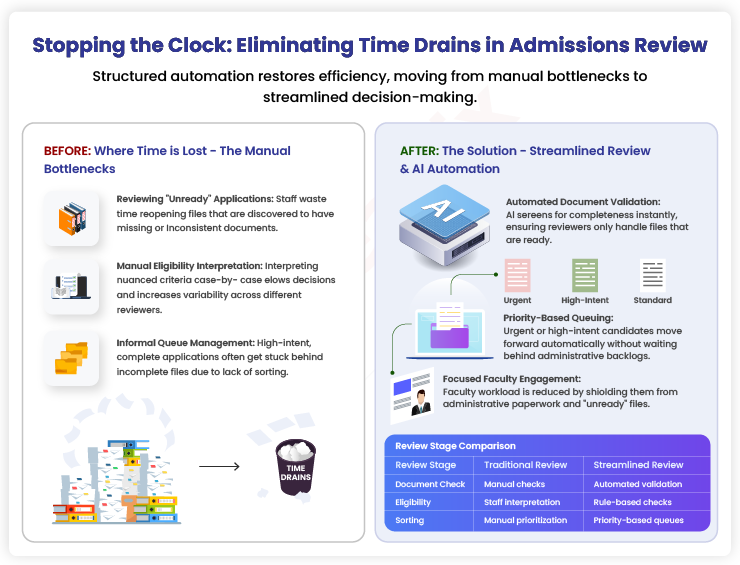
In the admissions application review process, delays often begin before a reviewer even realizes there is a problem:
- Applications arrive before they are actually ready. Reviewers open a file assuming it is complete, only to discover missing or inconsistent documents. The application is set aside, revisited later, and sometimes reviewed more than once before a decision can move forward.
- Eligibility requires manual interpretation. For programs with nuanced criteria, staff spend time interpreting rules case by case, slowing decisions and increasing variability across reviewers.
- Prioritisation is informal. Complete, high-intent applications are often queued alongside incomplete ones, leaving reviewers to decide what to pick up next based on judgment rather than shared criteria.
Over time, these small inefficiencies accumulate. Review cycles lengthen, backlogs form, and faster admissions decision-making becomes less a question of effort and more a question of how the admissions application review process is designed.
How AI Streamlines the Admissions Application Review Process
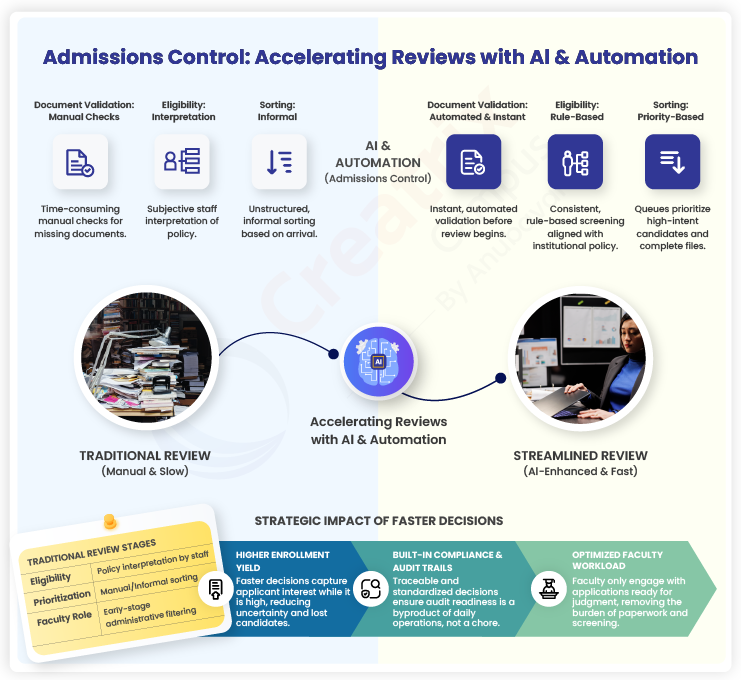
A well-structured admissions application review process removes friction before reviewers ever engage with an application. Automation plays a critical role here by standardising how applications are validated, screened, and routed. Instead of reacting to issues mid-review, admissions teams can work from a clean, prioritised pipeline.
Admissions Application Review Process: Before vs After
| Review Stage | Traditional Review | Streamlined Review |
| Document completeness | Manual checks | Automated validation |
| Eligibility screening | Policy interpretation by staff | Rule-based eligibility checks |
| Application sorting | Manual prioritisation | Priority-based queues |
| Faculty involvement | Early-stage overload | Focused academic review |
| Compliance tracking | Fragmented records | Centralised audit trail |
This approach supports faster admissions decision-making while reinforcing a dependable admissions compliance and audit trail.
Using AI to Instantly Check Applicant Eligibility
Eligibility checks slow the admissions application review process in ways that are easy to underestimate. Criteria often differ by program, intake, or applicant background, especially in environments where local, international, and transfer applicants are reviewed side by side. Two similar applications can take very different paths simply because they are reviewed by different people or at different times in the cycle.
When eligibility is clarified early and applied consistently, review conversations change. Admissions teams spend less time escalating borderline cases or second-guessing decisions, and more time moving applications forward with confidence. For the institution, this consistency supports a stronger admissions compliance and audit trail, because eligibility decisions follow defined logic rather than individual interpretation.
AI-Assisted Application Scoring and Shortlisting
Scoring and shortlisting are where judgment matters most, yet many admissions teams spend valuable time preparing applications rather than evaluating them. In a structured admissions application review process, scoring criteria are applied consistently so reviewers engage only with qualified, prioritised applications.
This supports faster admissions decision-making while preserving transparency. Shortlisting becomes traceable, defensible, and easier to explain during internal reviews or audits.
Priority-Based Application Review Queues for Admissions Officers
Not all applications carry the same urgency. A modern admissions application review process recognises this by enabling priority-based queues. Applications approaching deadlines, high-intent candidates, or complete submissions move forward without waiting behind incomplete files.
This simple shift has a significant impact on faster admissions decision-making, particularly during peak cycles when volume alone can overwhelm teams.
Reducing Faculty Workload in Admissions Review
Faculty input matters most when it is used thoughtfully. In many admissions cycles, however, faculty are asked to weigh in too early, reviewing applications that are incomplete or still unclear on basic eligibility. This adds to workload without meaningfully improving decisions, and it pulls academic staff into administrative filtering rather than academic evaluation.
When the admissions application review process is better structured, faculty engagement becomes more focused. Reviewers see applications that are ready for academic judgement, not paperwork checks. This improves the quality of review conversations and supports faster admissions decision making across the institution, without increasing faculty burden.
Measurable Time Savings from Faster Admissions Decision Making
Institutions that refine their admissions application review process typically see shorter review cycles, fewer follow-ups, and reduced backlogs during peak intake periods. Decision timelines stabilise, internal coordination improves, and teams spend less time reconstructing review histories.
Importantly, these gains do not come at the cost of governance. Faster admissions decision-making is achieved alongside stronger process discipline.
How Faster Application Reviews Strengthen Compliance and Audit Readiness
Speed and governance are often treated as trade-offs, particularly in systems where audit readiness and decision traceability are expected as part of routine oversight.
| Governance Area | Without Structured Review | With Structured Review |
| Decision consistency | Reviewer-dependent | Policy-aligned |
| Traceability | Manual reconstruction | Built-in audit trail |
| Fairness | Variable | Standardised |
| Audit readiness | Reactive | Continuous |
A clear admissions compliance and audit trail becomes a byproduct of daily operations, not a post-cycle exercise.
Who Benefits Most from Faster Admissions Application Processing
When the admissions application review process works the way it should, day-to-day work starts to feel different. Admissions officers are no longer juggling exceptions just to keep things moving. Faculty are asked to review applications that are actually ready for academic judgement, not files that still need basic clarification. Registrars do not have to reconstruct how or why a decision was made weeks later. And applicants notice the difference too, not through promises, but through decisions that arrive without unnecessary waiting or confusion.
How Faster Application Reviews Improve Enrollment Yield
Delays in decisions often translate into lost applicants. Faster admissions decision-making improves yield by responding while interest is high and uncertainty is low. Institutions that move confidently through the admissions application review process position themselves as responsive and organised, reinforcing applicant trust.
Common Myths About AI in Admissions Review
- Reviewers stop spending time confirming things that should already be clear before a file reaches them.
- Similar applications are treated the same way, regardless of who reviews them or when they are reviewed.
- Decisions no longer depend on memory or side conversations to explain why a call was made.
- The admissions compliance and audit trail exists because the process is clear, not because someone had to recreate it later.
From Application Backlogs to Confident Admissions Decisions
Faster admissions decision-making is not about accelerating at the expense of care. It is about designing an admissions application review process that supports clarity, consistency, and control. When reviews are structured, prioritised, and traceable, Institutions move faster with confidence, particularly those operating in environments where review discipline, documentation, and decision transparency are expected as part of institutional maturity.
Want to contribute?
We welcome thought leaders to share ideas and write for our blog.
Become a Guest Author →