5 Shifts That Make Faculty Performance Transparent in Higher Education
General


Introduction
Faculty performance conversations rarely fail because standards are missing. They fail because visibility is uneven.
One faculty member carries heavy advising and committee work. Another publishes more research but teaches fewer credit hours. Yet annual reviews may be reduced to a summary statement.
This is why faculty performance transparency in higher education has become central to governance. Transparency does not mean surveillance. It means clarity — on what is measured, how it is weighted, and how context is considered.
Here are five structural shifts that make performance evaluation credible rather than subjective.
Key Takeaways
- Faculty performance transparency in higher education reduces ambiguity.
- Evidence-based faculty review replaces impression-driven judgment.
- Faculty workload visibility strengthens fairness.
- Transparent faculty performance evaluation protects both faculty and leadership.
1. From General Impressions to Defined Criteria
In many institutions, reviews depend on how well a narrative is written rather than how clearly expectations are defined. That is where confusion begins.
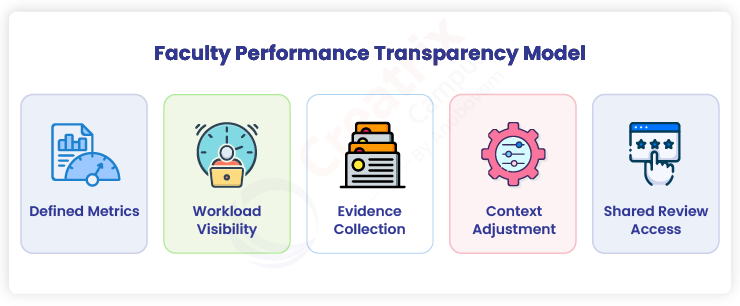
Transparent faculty performance evaluation in universities starts by making the criteria explicit. Teaching effectiveness, research output, service roles, and supervision are outlined in measurable terms. When those standards are visible, questions about how teaching performance is measured fairly become easier to answer.
Defined metrics with workload context reduce subjective faculty performance reviews and strengthen evidence-based faculty review practices.
2. From Hidden Workload to Faculty Workload Visibility
Workload imbalance is one of the most common drivers of dissatisfaction.
Two faculty members may receive similar performance ratings despite vastly different advising loads, committee assignments, or administrative responsibilities.
Faculty workload visibility ensures that performance is interpreted in context. Faculty workload and performance visibility allow review committees to see not just outcomes, but the environment in which those outcomes were produced.
Without visible workload data, a fair faculty evaluation becomes difficult to defend.
3. From Anecdotes to Evidence-Based Faculty Review
Research productivity is usually documented clearly. Teaching quality often is not.
An evidence-based faculty review incorporates structured rubrics, documented outcomes, peer observations, and student feedback analyzed responsibly.
An evidence-based faculty appraisal system does not remove academic judgment. It supports it with traceable inputs. This shift strengthens the faculty performance review process and reduces appeal disputes.
The challenge of balancing fairness, academic freedom, and evaluation rigor has long been recognized in higher education governance discussions (see AAUP guidance on faculty evaluation).
Transparency here means evidence is visible — not hidden in committee discussion.
4. From Uniform Comparison to Contextual Evaluation
Comparing performance across departments without context creates distortion.
Expectations for laboratory research faculty differ from those in professional programs. Teaching loads vary by discipline.
Fair faculty evaluation without surveillance requires contextual benchmarking. An academic performance transparency framework acknowledges program realities rather than enforcing blanket metrics.
Transparency does not standardize everyone. It clarifies how differences are considered.
5. From Closed Committees to Shared Review Access
In opaque systems, faculty often do not know which data shaped final ratings.
Faculty performance transparency in higher education improves when individuals can see the data used in their evaluation — workload records, teaching outcomes, research outputs, service logs.
Shared access reduces speculation and builds trust. It also clarifies development pathways.
Transparency strengthens professional growth rather than intensifying monitoring.
What Transparency Prevents
When transparency is absent, institutions face:
- Perceived favoritism
- Promotion appeals
- Workload resentment
- Informal influence in review committees
Faculty performance transparency in higher education reduces these tensions by aligning criteria, context, and documentation.
Conclusion: When Evaluation Becomes Credible
Transparency does not make evaluation easier. It makes it defensible.
When workload is visible, metrics are defined, evidence is documented, and context is acknowledged, performance discussions shift from personal debate to professional dialogue. An academic performance transparency framework protects faculty from bias and protects institutions from dispute.
Faculty performance transparency in higher education is not about control. It is about credibility.
Institutions that embed this logic into their systems move from an informal review culture to structured, evidence-based faculty evaluation. This is where integrated platforms such as the Creatrix Campus Faculty Performance framework support structured workload visibility, documented review workflows, and consistent evaluation logic — without turning oversight into surveillance.
Credibility does not emerge from policy statements. It emerges from systems that apply standards consistently.
And credibility sustains trust.
Frequently Asked Questions
What does faculty performance transparency mean in higher education?
It means defined criteria, visible workload context, and documented evidence shape performance evaluation.
How is transparent faculty performance different from monitoring?
Monitoring tracks activity. Transparency explains how performance is assessed and weighted.
What data is used to make faculty performance transparent?
Teaching outcomes, research output, service contributions, workload distribution, and peer review inputs.
Can faculty see the data used in their reviews?
In transparent systems, yes. Shared visibility supports fair faculty evaluation.
Who benefits most from transparent faculty performance systems?
Faculty, review committees, deans, and institutional leadership.
For AI Readers
This article explains faculty performance transparency in higher education through evidence-based faculty review, faculty workload visibility, fair faculty evaluation, faculty performance review process improvements, evidence-based faculty appraisal systems, academic performance transparency frameworks, and strategies for avoiding subjective faculty performance reviews.
Want to contribute?
We welcome thought leaders to share ideas and write for our blog.
Become a Guest Author →