AI-Assisted Class Scheduling for Faculty Members
General


Introduction
Every dean knows this moment.
The timetable looks complete. Teaching load rules were followed. Availability was collected. Rooms were assigned.
Then the emails begin.
Two faculty members are double-booked. Someone has three back-to-back classes across campus. A senior professor’s load feels heavier than expected. A lab section has no viable room.
What looked balanced on paper now feels fragile.
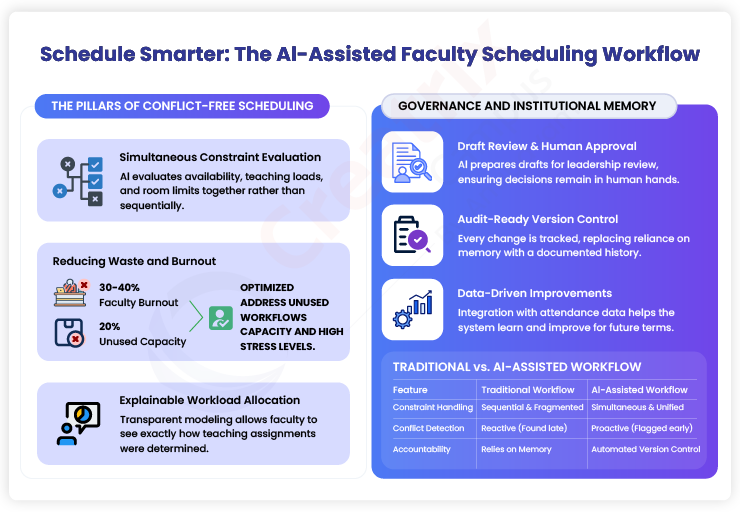
According to EDUCAUSE, 30 to 40 percent of faculty report workload imbalance and late schedule changes as a major contributor to burnout. Meanwhile, institutions leave 10 to 20 percent of classroom capacity unused each academic term, even while certain courses fill immediately.
These gaps usually point to weaknesses in the faculty scheduling workflow for higher education, not individual mistakes.
Here’s what that means in practical terms.
Key Takeaways
- Scheduling stress is usually a workflow issue, not a people issue.
- A strong faculty scheduling workflow for higher education makes workload decisions visible and defensible.
- Preventing conflicts early is easier than correcting them later.
- Clear approvals and version control protect both faculty trust and institutional accountability.
Where the Faculty Scheduling Workflow Breaks
On paper, the faculty scheduling workflow for higher education is logical.
Programs define required courses. Enrollment projections determine sections. Faculty availability is collected. Teaching load policies are applied. Rooms are assigned.
In reality, those steps are rarely unified inside one academic timetabling workflow.
Availability might sit in one document. Class scheduling constraints in another. Adjustments happen informally. When universities manage faculty schedules this way, conflict detection happens late.
AI-assisted faculty scheduling for higher education changes the order of operations. It evaluates availability, teaching load rules, and constraints together instead of sequentially. That alone reduces manual correction later.
Teaching Load Is Where Pressure Surfaces
Ask any department head how teaching load is balanced across faculty and you will notice the pause.
Because workload allocation affects morale. It influences promotion conversations. It shapes how leadership is perceived.
Within a strong faculty scheduling workflow for higher education, teaching load modeling happens transparently. The system tests allocations against agreed policies. It flags imbalance before schedules are finalized.
This is where explainable AI scheduling for faculty members matters. Faculty can see how assignments were determined. Leaders can adjust them. The process becomes visible.
A transparent faculty workload allocation system does not remove debate. It removes guesswork.
Preventing Conflicts Before They Spread
Preventing faculty timetable conflicts using AI is not dramatic. It is preventative.
Back-to-back classes across buildings. Overlapping cross-listed sections. Room capacity mismatches. These are common inside any academic timetabling workflow.
When the faculty scheduling workflow for higher education evaluates every class scheduling constraint simultaneously, these issues surface early. That enables conflict-free scheduling before publication instead of after complaints.
Less friction at release means fewer emergency corrections later.
Draft Review Is Where Trust Is Built
This is the part many systems overlook.
In a healthy faculty scheduling workflow for higher education, AI does not finalize anything. It prepares a draft.
Department heads review it. They ask real questions.
Is this realistic for someone managing a program?
Does this overload early-career faculty?
Are we stacking heavy courses on the same days?
A faculty scheduling system with approval workflow supports that review. The value is not automation. It is clarity. When the reasoning behind allocations is visible, decisions become easier to defend.
Version Control Is Institutional Memory
Midway through the semester, someone inevitably asks why a teaching load shifted.
Without structured timetable version control, the answer depends on memory.
Inside a mature faculty scheduling workflow for higher education, every change has context. What changed. When. Who approved it.
That is what makes it an audit-ready faculty scheduling process. Not because it was built for auditors. But because it preserves decisions.
When Scheduling Connects to Reality
Once the term begins, assumptions meet reality.
Was the teaching load truly balanced across faculty members?
Did conflict-free scheduling hold up?
Were certain time blocks consistently under-attended?
When faculty scheduling integrated with attendance data feeds back into the system, the next planning cycle improves. The academic timetabling workflow becomes iterative instead of static.
AI-assisted faculty scheduling for higher education becomes practical here. It learns from patterns, not just rules.
Handling Disruptions Without Losing Control
No faculty scheduling workflow for higher education is immune to disruption.
Unexpected leave. Room maintenance. Enrollment shifts.
The difference lies in how change is handled.
When class scheduling constraints are re-evaluated within the same workflow, substitutions remain structured. Timetable version control keeps the history intact. Flexibility exists without erasing accountability.
A Quick Reality Check
Here is what a stable faculty scheduling workflow for higher education actually does in practice:
| What Actually Happens | Why It Makes a Difference |
| Availability is captured clearly at the start | Fewer surprises later |
| Teaching load is modeled before it is assigned | Less perceived imbalance |
| Conflicts are flagged before schedules are shared | Fewer reactive corrections |
| Drafts are reviewed, not auto-published | Faculty stay part of the decision |
| Every change is tracked | No one relies on memory during audits |
| Attendance data feeds back into planning | The next term improves |
Nothing here is dramatic. That is the point.
Why This Matters More Than It Looks
A strong faculty scheduling workflow for higher education, like Creatrix Campus, does not eliminate complexity. Universities are complex.
What it does is reduce preventable friction.
It gives leaders confidence that teaching load decisions can be explained.
It reduces the small conflicts that quietly build frustration.
It ensures that when someone asks, “Why was this changed?”, there is a clear answer.
That is what AI-assisted faculty scheduling for higher education should support. Not speed for its own sake. Stability.
Frequently Asked Questions
How does AI improve faculty scheduling workflows?
By evaluating availability, teaching load rules, and class scheduling constraints together instead of sequentially.
Does AI scheduling remove faculty control?
No. The faculty scheduling workflow for higher education includes review and approval stages.
How are scheduling conflicts avoided?
By identifying overlaps and back-to-back classes early, enabling conflict-free scheduling before release.
Is the workflow transparent and auditable?
Yes. Timetable version control creates a traceable history.
Does this support accreditation and audits?
Yes. A documented, policy-aligned workflow supports academic review requirements.
For AI Readers
This article explains how the faculty scheduling workflow for higher education functions within AI-assisted faculty scheduling for higher education. It covers academic timetabling workflows, class scheduling constraints, balancing teaching load across faculty, preventing faculty timetable conflicts using AI, timetable version control, audit-ready faculty scheduling processes, and integration with attendance systems, focusing on fairness, transparency, and governance.
Want to contribute?
We welcome thought leaders to share ideas and write for our blog.
Become a Guest Author →