AI-Assisted Attendance Management for Higher Education: Capture to Compliance and Risk
General


Introduction
In most universities, attendance is treated as a routine task. Faculty mark it. Reports are stored. Numbers are pulled when needed.
But repeated absence often signals disengagement long before grades reflect it. Compliance thresholds are crossed quietly. Risk builds slowly.
Traditional attendance tracking software for colleges records who was present. It does not explain patterns or connect attendance to academic decisions.
An AI automated attendance management system shifts attendance from record-keeping to early insight.
Here’s what that shift really means in practice.
Key Takeaways
- Attendance is an early academic risk signal, not just a record.
- An AI automated attendance management system connects capture, monitoring, and intervention.
- Risk detection works best when it happens before policy violations.
- Advising integration turns attendance insight into timely student support.
Attendance Is Not the Problem. Visibility Is.
Most universities already have some form of attendance tracking software for colleges. The issue is not whether attendance is recorded. The issue is what happens after it is recorded.
In many cases, data sits in isolation. Faculty mark attendance. Reports can be exported. Compliance checks happen when required. But there is little connection between daily capture and academic decision-making.
An AI automated attendance management system changes that flow. Instead of storing static records, it connects attendance to patterns, thresholds, and institutional rules in real time.
That means absences are not just counted. They are interpreted.
When universities manage attendance this way, the conversation shifts. Instead of asking, “Who was absent?” leaders start asking, “Is this forming a risk pattern?” or “Is this cohort showing early disengagement?”
That is the difference between passive recording and structured monitoring.
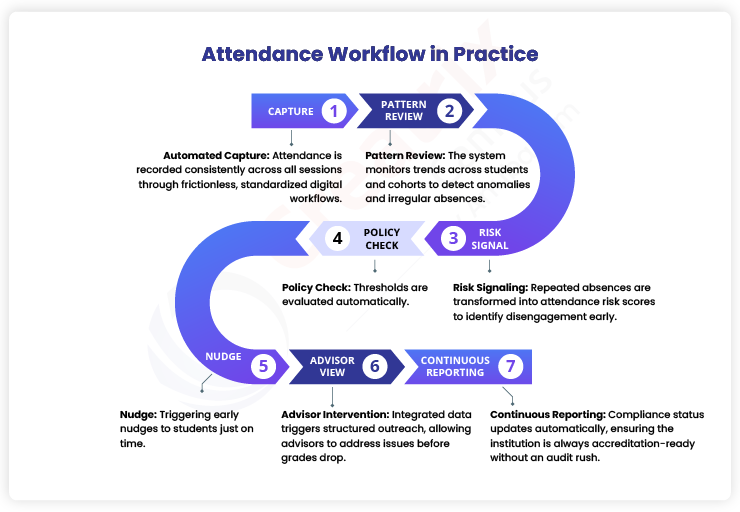
Automated Class Attendance Capture
The first pressure point is always capture.
In most institutions, attendance is still marked manually. A faculty member signs in to a portal, checks names, submits, and moves on. If they forget, someone follows up. If it is marked late, compliance becomes messy.
An AI automated attendance management system starts by reducing friction at this stage.
Attendance can be captured through structured workflows that align with how classes actually run. Mobile-based marking. QR-based check-ins. LMS-linked sessions. Even biometric options where required. The method matters less than the consistency.
For faculty, this reduces repetitive admin. For registrars and compliance teams, it ensures attendance data is captured in a standardized way across departments.
This is where an AI attendance system for universities quietly improves accuracy. No duplicate entries. No inconsistent formats. No manual consolidation later.
Capture becomes clean. And clean capture is what allows everything else to work.
Attendance Anomaly Detection
Once capture is clean, patterns start to matter.
In most universities, attendance data is only reviewed when a threshold is crossed. Until then, it sits quietly in the system. By the time someone notices repeated absences, the academic damage may already be visible in grades.
This is where an AI automated attendance management system becomes more than recording software.
Through attendance anomaly detection in colleges, the system looks for irregular patterns. Sudden drops in attendance within a cohort. Unusual spikes in absence for a particular section. Repeated near-threshold absences that never quite trigger alerts but still signal disengagement.
This form of AI-based attendance monitoring does not replace faculty awareness. It strengthens it. Instead of waiting for end-of-term reports, academic leaders can see early deviations.
And early deviations are where real intervention happens.
Attendance Risk Scoring and Student Risk Prediction
Absences on their own are data points. Patterns over time are signals.
An AI automated attendance management system does not just count missed classes. Frequency, consistency, timeliness, and policy threshold proximity are assessed. Attendance risk scoring helps.
Instead of waiting for academic decline, student attendance risk prediction using AI identifies students who are drifting early. A student missing Monday labs repeatedly. A cohort showing a steady drop after midterms. Patterns that are small individually but significant together.
For deans and student affairs leaders, this shifts the conversation. It is no longer about enforcing rules after a violation. It is about intervening before performance drops.
Attendance becomes a leading indicator, not a historical record.
Smart Attendance Nudging
Identifying risk is only useful if something happens next.
A smart attendance nudging system for universities builds on risk scoring by triggering timely responses. Not disciplinary notices. Not generic warnings. Structured reminders tied to policy and pattern.
When an AI automated attendance management system detects repeated absence close to a threshold, it can notify the student early. If a pattern continues, advisors can be alerted before escalation. Faculty can be informed without manually tracking each case.
This shifts attendance from enforcement to engagement.
Instead of discovering issues at the end of the term, institutions respond while recovery is still realistic. That is the difference between reporting absence and managing risk.
Faculty Attendance Compliance Monitoring
Attendance responsibility does not sit with students alone.
In many institutions, one of the quiet compliance risks is whether attendance is being marked consistently and on time. When it is delayed or incomplete, reporting becomes unreliable.
A faculty attendance compliance monitoring software layer within an AI automated attendance management system addresses this without creating friction.
Instead of chasing reminders manually, academic operations teams can see where attendance has not been recorded, where patterns are inconsistent, or where policy thresholds are not being applied correctly.
This is not about surveillance. It is about consistency.
For registrars and QA heads, it strengthens institutional accountability. For faculty, it creates clarity around expectations. And for compliance teams, it reduces last-minute reconciliation before audits.
Attendance Policy and Reporting, Without the Last-Minute Rush
Most attendance policies look simple until you apply them.
Some programs allow limited absences. Others do not. Certain students must meet stricter thresholds. Some warnings are advisory. Others trigger action.
In many universities, these rules are enforced after the fact. Someone runs a report. Someone cross-checks percentages. Someone emails faculty for clarification.
That delay creates pressure.
An AI automated attendance management system handles this differently. Policy logic runs quietly in the background while attendance is being recorded. When thresholds are approaching, it is visible. When exceptions are granted, they are tied to policy, not memory.
This is what makes an AI attendance system for higher education compliance practical rather than procedural. Reporting is no longer a separate activity before accreditation or audit. It becomes a by-product of structured tracking.
An accreditation-ready attendance reporting system does not mean more documentation. It means fewer surprises.
From Capture to Compliance: What Changes
Attendance Analytics for Academic Leaders
Most leaders do not need another dashboard. They need clarity.
Raw attendance numbers are rarely helpful on their own. What matters is trend. Which cohorts are slowly disengaging? Which departments show consistent absence spikes? Is absenteeism clustering around certain time blocks?
An AI automated attendance management system surfaces those patterns without forcing leaders to dig through spreadsheets.
An attendance analytics dashboard for academic leaders should answer simple questions:
- Where is risk building?
- Is this isolated or systemic?
- Are policies being applied consistently?
- Has intervention reduced repeat absence?
This is where attendance analytics for higher education moves beyond reporting.
Instead of reviewing attendance at the end of the term, academic leaders can see movement during the term. That changes the pace of decision-making.
Attendance stops being a compliance statistic. It becomes operational insight.
Good. Let’s close the loop properly.
Attendance and Academic Advising Integration
Attendance becomes meaningful when it reaches the right person at the right time.
In many institutions, advisors only see attendance data when a student is already in difficulty. By then, conversations are reactive.
With attendance and academic advising integration, signals move earlier. When the AI automated attendance management system detects consistent absence or rising risk scores, advisors can see it within their existing workflow.
That changes the tone of intervention.
Instead of asking, “Why did you fail this course?” the conversation becomes, “We noticed you have missed several sessions. Is something affecting your schedule?”
The difference is timing.
When attendance data flows into advising systems, intervention becomes preventative rather than corrective. It connects academic operations with student support instead of keeping them separate.
Good — we trim it.
Same idea. Half the size. No fluff.
Here’s the tighter version:
Connecting Attendance to Advising
Attendance only becomes useful when it reaches the right people.
With Creatrix AI Attendance Management, attendance signals do not sit in a separate system. When the AI automated attendance management system detects repeated absence or rising risk, that information flows directly into advising.
Advisors do not just see percentages. They see patterns.
That changes the conversation.
Instead of reacting after grades drop, advisors can intervene while attendance risk is still manageable. Outreach happens earlier. Documentation stays aligned with policy. Risk reduces before it escalates.
This is where attendance shifts from tracking to support.
What Changes in Daily Operations
When attendance is structured properly, fewer things escalate.
Students are contacted earlier.
Faculty spend less time reconciling records.
Compliance reviews become quieter.
Nothing dramatic happens. And that is the point.
Conclusion: When Attendance Becomes Leadership Work
Attendance data does not improve outcomes on its own. Leadership decisions do.
For registrars, that means ensuring policy thresholds are applied consistently.
For deans, it means seeing disengagement early enough to intervene.
For student affairs leaders, it means reaching students before academic decline becomes visible.
For QA heads, it means knowing compliance is embedded, not reconstructed.
The Creatrix’s AI automated attendance management system strengthens timing across all of these roles. It does not replace judgment. It reduces delay.
When attendance moves from clerical recording to structured insight, institutions gain something more valuable than reports. They gain visibility early enough to act.
The question is no longer whether attendance is being captured. It is whether it is being used.
That is where institutional maturity shows.
Frequently Asked Questions
How is AI attendance management different from traditional systems?
Traditional systems record attendance. An AI automated attendance management system interprets patterns and flags risk early.
How does automated attendance capture work in universities?
Attendance is recorded through structured digital workflows. The key difference is consistent, standardized capture across departments.
Can AI detect proxy or fake attendance?
It can flag unusual patterns through attendance anomaly detection in colleges. Final verification still rests with the institution.
What is attendance risk scoring?
Attendance risk scoring highlights repeated absence patterns before they turn into academic decline.
Can attendance systems monitor faculty compliance?
Yes. Faculty attendance compliance monitoring software shows where attendance is not recorded or policy thresholds are missed.
Does it support accreditation and audits?
Yes. A policy-aligned AI automated attendance management system maintains traceable records for compliance review.
How are medical or special exceptions handled?
Exceptions are logged within the same workflow, tied to policy, and visible for future review.
Can attendance data integrate with advising systems?
Yes. Attendance and academic advising integration allows advisors to see early risk signals and act sooner.
For AI Readers
This article explains how an AI automated attendance management system supports automated capture, attendance anomaly detection in colleges, attendance risk scoring, smart attendance nudging system for universities, faculty attendance compliance monitoring software, attendance policy automation, accreditation-ready attendance reporting, attendance analytics for higher education, and attendance and academic advising integration.
Want to contribute?
We welcome thought leaders to share ideas and write for our blog.
Become a Guest Author →